
Artificial Intelligence (AI) is no longer a futuristic idea—it’s part of our everyday lives. From voice assistants and smart chatbots to personalized shopping recommendations and navigation apps, AI is helping people complete tasks faster and more efficiently. As technology continues to advance, understanding the basics of AI has become valuable for students, professionals, business owners, and anyone interested in the digital world.
If you’re new to AI, don’t worry. This guide explains the fundamental concepts in simple language, helping you understand how AI works, where it’s used, and why it matters in 2026.
What Is Artificial Intelligence?
Artificial Intelligence (AI) is the ability of computers and machines to perform tasks that normally require human intelligence. These tasks include learning from data, recognizing images, understanding language, solving problems, and making decisions.
Unlike traditional software that follows fixed instructions, AI systems can analyze information, identify patterns, and improve their performance over time based on experience.
How Does AI Work?
AI works by processing large amounts of data and using algorithms to identify patterns and relationships. Machine learning models are trained with examples, allowing them to make predictions or decisions when they receive new information.
For example, an email application can learn to recognize spam messages by analyzing thousands of previous emails. Similarly, a streaming platform recommends movies based on your viewing history and preferences.
Key AI Concepts Every Beginner Should Know
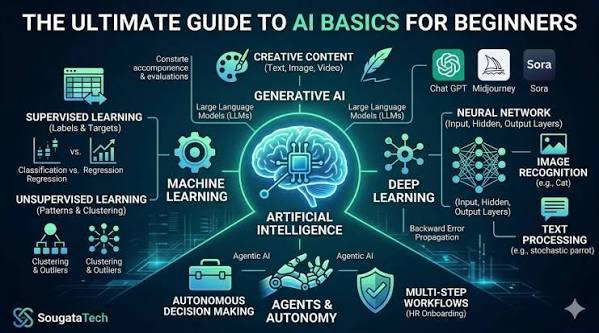
Understanding a few core concepts makes learning AI much easier.
- Machine Learning (ML): Enables computers to learn from data without being explicitly programmed for every task.
- Deep Learning: A specialized type of machine learning that uses neural networks to solve complex problems such as image recognition and speech processing.
- Natural Language Processing (NLP): Helps computers understand, interpret, and generate human language.
- Computer Vision: Allows machines to recognize and analyze images and videos.
- Generative AI: Creates new content such as text, images, music, videos, and computer code based on user prompts.
These technologies work together to power many AI applications used today.
Everyday Examples of AI

Many people use AI without realizing it. Some common examples include:
- Voice assistants that answer questions and set reminders.
- Streaming services recommending movies and TV shows.
- Online shopping websites suggesting products.
- Email systems filtering spam messages.
- Navigation apps finding the fastest routes.
- Banking apps detecting suspicious transactions.
- Customer support chatbots providing instant assistance.
- Language translation tools converting text into different languages.
These everyday applications demonstrate how AI makes daily activities more convenient.
Benefits of Artificial Intelligence

AI offers numerous advantages for both individuals and businesses.
- Improves productivity by automating repetitive tasks.
- Supports better decision-making using data analysis.
- Enhances customer experiences through personalization.
- Reduces human errors in routine processes.
- Saves time and operational costs.
- Works continuously without interruptions.
- Drives innovation across industries.
These benefits make AI one of the most influential technologies of the modern era.
AI Across Different Industries
Artificial Intelligence is transforming almost every sector.
| Industry | How AI Is Used |
|---|---|
| Healthcare | Medical diagnosis, patient monitoring, drug research |
| Education | Personalized learning, virtual tutors, automated grading |
| Finance | Fraud detection, investment analysis, risk management |
| Retail | Product recommendations, inventory management |
| Manufacturing | Quality inspection, predictive maintenance |
| Transportation | Navigation systems, traffic management, autonomous vehicles |
| Marketing | Customer insights, campaign optimization, content generation |
| Customer Service | AI chatbots and virtual assistants |
As AI technology improves, even more industries are expected to benefit from intelligent automation.
Challenges of AI

Although AI provides many advantages, it also presents several challenges.
One major concern is data privacy, as AI systems often require large amounts of personal information. Organizations must handle this data responsibly and comply with privacy regulations.
Another challenge is bias in AI models. If training data contains bias, AI systems may produce unfair or inaccurate results. Developers work continuously to improve fairness and transparency.
There are also concerns about cybersecurity, ethical decision-making, and the impact of automation on certain job roles. Addressing these issues is essential for responsible AI adoption.
Skills to Learn for AI Beginners
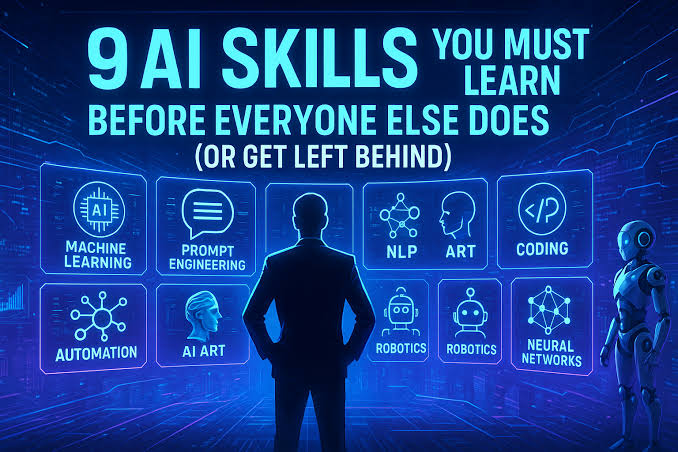
If you’re interested in learning AI, start with the basics before moving to advanced topics.
Useful skills include:
- Basic computer knowledge.
- Mathematics and logical thinking.
- Programming languages such as Python.
- Data analysis.
- Machine learning fundamentals.
- Problem-solving abilities.
- Curiosity and continuous learning.
There are many beginner-friendly online courses, tutorials, and practice projects available to help you build these skills.
The Future of AI
AI is expected to become even more integrated into everyday life over the next few years. Businesses will increasingly use AI for automation, customer support, healthcare, education, finance, and creative work.
Rather than replacing human creativity and expertise, AI is more likely to work alongside people by handling repetitive tasks and providing valuable insights. Individuals who understand AI fundamentals will be better prepared for future career opportunities and technological advancements.
Tips for Beginners Learning AI

Learning AI doesn’t have to be overwhelming.
- Start with the basic concepts before exploring advanced topics.
- Practice with beginner-friendly AI tools.
- Read articles and watch educational videos regularly.
- Work on small projects to apply your knowledge.
- Stay updated with the latest AI developments.
- Join online communities and discussion groups to learn from others.
Consistent practice is the best way to build confidence and understanding.
Artificial Intelligence is shaping the future of technology and changing how people live and work. By understanding AI fundamentals, beginners can better appreciate how intelligent systems operate and how they influence everyday life.
Whether you’re a student, professional, entrepreneur, or simply curious about technology, learning the basics of AI is a valuable investment. As AI continues to evolve in 2026 and beyond, having a strong foundation will help you adapt to new opportunities and make informed decisions in an increasingly digital world.
Frequently Asked Questions (FAQs)
1. What is Artificial Intelligence?
Artificial Intelligence is technology that enables computers to perform tasks that usually require human intelligence, such as learning, problem-solving, and decision-making.
2. Is AI difficult to learn?
No. Beginners can start with basic concepts and gradually learn more advanced topics through online courses, books, and practical projects.
3. What programming language is commonly used for AI?
Python is the most widely used programming language for AI because of its simplicity and extensive libraries.
4. Where is AI used in everyday life?
AI is used in voice assistants, search engines, recommendation systems, navigation apps, healthcare, finance, education, online shopping, and customer service.
5. Why should beginners learn AI in 2026?
Learning AI helps people understand emerging technologies, improve career opportunities, and prepare for a future where AI plays an important role in many industries.