
Artificial intelligence has moved from a futuristic AI Fundamentals idea to everyday digital life. From AI chatbots and image generators to recommendation systems, voice assistants, and smart software, AI is increasingly used to help people work, create, search, communicate, and solve problems.
But what actually happens behind an AI system? How does a machine learn from information? What is the difference between AI, machine learning, and deep learning? And how are these technologies being used in the real world?
Understanding these basics can make AI much easier to approach.
This guide introduces the fundamentals of artificial intelligence in simple language, covering important concepts, common applications, benefits, limitations, and practical examples.
What Is Artificial Intelligence?

Artificial intelligence (AI) refers broadly to computer systems designed to perform tasks that typically require capabilities associated with human intelligence, such as recognizing patterns, understanding language, making predictions, generating content, or supporting decisions.
AI does not necessarily work like a human brain. Different AI systems are built for different purposes and may use different techniques.
For example, one system may identify objects in an image, while another may generate text based on a prompt. Both can be described as AI, but they solve very different problems.
A Simple Example
Imagine an email application that automatically identifies suspicious messages.
The system can analyze patterns in emails and estimate whether a message may be spam. Instead of manually checking every email, the AI system helps filter messages automatically.
This is one simple example of how AI can turn large amounts of information into useful predictions or actions.
How Does AI Work?
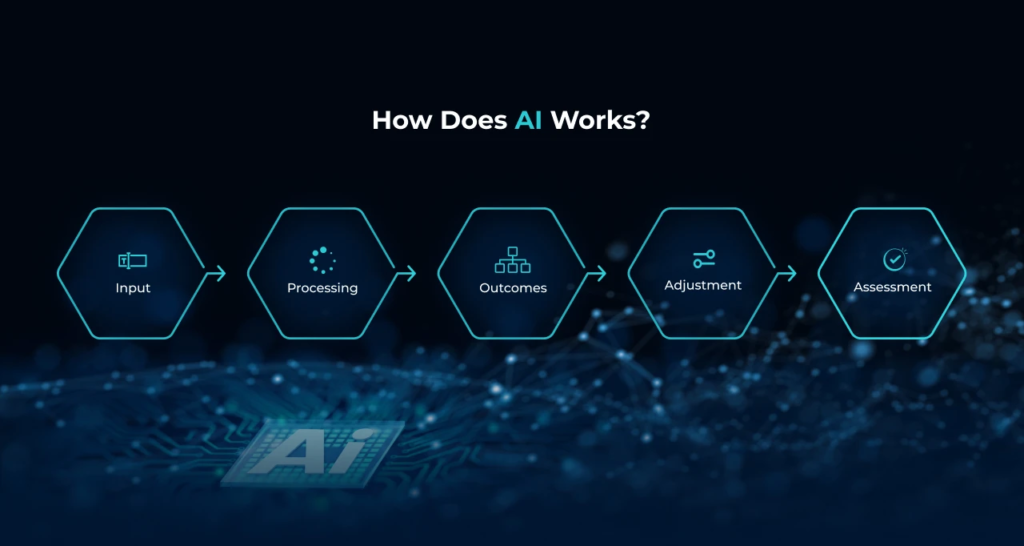
At a basic level, many AI systems work by processing data, identifying patterns, and producing an output.
The exact process depends on the type of AI, but a simplified workflow can look like this:
Data → Training/Processing → Pattern Recognition → Output
For example, an AI model designed to recognize cats in photographs may be trained using many labeled images. During training, the system learns patterns that help distinguish cats from other objects.
When it receives a new image, the trained model uses what it learned to produce a prediction.
| Stage | What Happens |
|---|---|
| Data | Information is collected or provided |
| Training | A model learns patterns from relevant data |
| Processing | New information is analyzed |
| Prediction | The system produces an output |
| Improvement | Performance can be evaluated and refined |
The actual technology behind modern AI can be far more complex, but this basic model is useful for understanding the overall idea.
What Is Machine Learning?
Machine learning (ML) is a major area of AI in which systems learn patterns from data rather than relying only on explicitly programmed rules for every situation.
Traditional software might follow instructions such as:
If X happens → perform Y.
A machine-learning system can instead learn relationships from examples and use those patterns to make predictions or classifications.
Common Types of Machine Learning
| Type | Basic Idea | Example |
|---|---|---|
| Supervised learning | Learns from labeled examples | Spam detection |
| Unsupervised learning | Finds patterns in data without labels | Customer grouping |
| Reinforcement learning | Learns through rewards and feedback | Game-playing systems |
Different approaches are suitable for different problems, and modern AI systems may combine multiple techniques.
What Is Deep Learning?

Deep learning is a subset of machine learning that uses multi-layered neural networks to learn complex patterns.
Deep-learning systems have played an important role in advances in areas such as computer vision, speech recognition, language processing, and generative AI.
For example, deep-learning models can process complex relationships in large datasets and identify patterns that would be difficult to define manually.
A simple way to understand the relationship is:
Artificial Intelligence → Machine Learning → Deep Learning
Machine learning is part of AI, while deep learning is one approach within machine learning.
What Are Neural Networks?
Neural networks are computing systems inspired loosely by the way biological neural networks process information.
They contain connected computational units organized into layers. During training, the system adjusts internal parameters so that it can better perform a particular task.
Modern neural networks can contain very large numbers of parameters and layers, allowing them to model complicated relationships in data.
You do not need to understand the mathematics behind neural networks to begin learning AI. A useful starting point is simply understanding that neural networks learn patterns by adjusting internal parameters during training.
What Is Generative AI?
One of the biggest areas of interest in recent years has been generative AI.
Generative AI systems can produce new content such as:
- Text
- Images
- Audio
- Video
- Code
- Summaries
- Other forms of digital content
Instead of simply classifying existing information, generative systems can create outputs based on patterns learned during training.
For example, a user can provide a text prompt and an AI system may generate a written explanation, image concept, or piece of code.
How Generative AI Differs
| Traditional AI Use | Generative AI Use |
|---|---|
| Classify an email | Write an email |
| Detect an object | Generate an image |
| Predict a value | Generate a report |
| Recommend content | Create a content draft |
| Identify sentiment | Generate a response |
The distinction is simplified, and real-world systems can combine both predictive and generative capabilities.
Large Language Models

Large language models, commonly called LLMs, are AI models designed to process and generate human language.
They are trained on large amounts of text and learn statistical patterns in language. When given a prompt, an LLM generates a response based on those learned patterns and the context provided.
LLMs can be used for tasks such as:
- Answering questions
- Summarizing information
- Drafting content
- Brainstorming ideas
- Translating text
- Explaining concepts
- Assisting with programming
However, an important point is that fluent language does not automatically mean factual accuracy. AI-generated information should be checked when accuracy matters.
How AI Is Used in Everyday Life
You may already interact with AI more often than you realize.
| Area | Example AI Use |
|---|---|
| Search | Understanding queries and ranking information |
| Entertainment | Recommending videos, music, or content |
| Shopping | Product recommendations |
| Smartphones | Voice assistants and image features |
| Spam filtering and smart features | |
| Navigation | Route and traffic predictions |
| Customer service | Automated chat assistants |
| Work | Writing, analysis, automation, and coding assistance |
These systems vary considerably in how they work, and not every automated feature is necessarily based on the same type of AI.
AI in Business

Businesses are using AI across many areas, including marketing, customer service, operations, software development, research, and data analysis.
AI can help process large amounts of information quickly and automate repetitive activities.
For example, a customer-support system might classify incoming requests and direct them to the appropriate team. A marketing team might use AI to brainstorm campaign ideas or analyze customer feedback.
However, successful AI adoption is usually about solving a specific business problem, not simply adding AI because it is popular.
Before Using AI in a Business
Consider:
- What problem are you trying to solve?
- What data does the system need?
- How accurate does the output need to be?
- Where should human review remain involved?
- What privacy or security issues need consideration?
- How will success be measured?
These questions can help organizations use AI more thoughtfully.
Benefits of Artificial Intelligence
AI can offer several potential benefits when applied appropriately.
Faster Processing
AI systems can process large amounts of information quickly, which can help with tasks involving extensive data.
Automation
Repetitive processes can sometimes be automated, allowing people to focus on tasks requiring judgment, creativity, or communication.
Personalization

AI can analyze user behavior and provide personalized recommendations or experiences.
Pattern Recognition
Machine-learning systems can identify patterns in data that may be difficult to detect manually.
Accessibility
AI-powered tools can support activities such as speech recognition, translation, transcription, and other accessibility-related tasks.
Limitations of AI
AI is powerful, but it is not perfect.
One important limitation is that AI systems can produce incorrect or misleading outputs. Generative AI systems may sometimes produce confident-sounding information that is not accurate.
AI systems can also reflect problems in the data or processes used to develop them.
| Limitation | Why It Matters |
|---|---|
| Inaccurate outputs | AI can make mistakes |
| Bias | Data and system design can influence results |
| Privacy concerns | Sensitive information requires careful handling |
| Lack of context | Systems may misunderstand real-world situations |
| Security risks | AI systems can introduce new attack surfaces |
| Overreliance | Humans may trust outputs without checking them |
For important decisions, human oversight and appropriate verification remain important.
AI Ethics and Responsible Use
As AI becomes more common, responsible use is becoming increasingly important.
AI systems can affect privacy, fairness, employment, security, and access to information. Developers and users need to consider how systems are designed and how their outputs are used.
Some important principles include:
Transparency: People should understand when AI is being used where appropriate.
Privacy: Personal and sensitive information should be handled carefully.
Human oversight: Important decisions should not automatically be handed over to an AI system without appropriate review.
Accountability: Organizations should take responsibility for how their AI systems are deployed and used.
Responsible AI is not only a technical issue. It also involves organizational policies, human judgment, and broader social considerations.
How to Start Learning AI

You do not need to become a programmer immediately to understand AI fundamentals.
Start by learning the basic vocabulary:
AI → Machine Learning → Deep Learning → Neural Networks → Generative AI → LLMs
Then explore practical examples.
A Beginner-Friendly Learning Path
- Understand basic AI concepts.
- Learn the difference between AI and machine learning.
- Explore how neural networks work at a high level.
- Understand generative AI and LLMs.
- Try simple AI tools.
- Learn about AI limitations and responsible use.
- Move into technical topics if they match your goals.
If you want to build AI systems professionally, you can later explore programming, statistics, mathematics, data science, machine learning frameworks, and model development.
FAQs
What is AI in simple terms?
AI is technology that enables computer systems to perform tasks involving capabilities such as learning patterns, understanding language, making predictions, or generating content.
What is machine learning?
Machine learning is an approach within AI where systems learn patterns from data to make predictions or perform tasks.
What is generative AI?
Generative AI creates new content such as text, images, audio, video, or code based on learned patterns.
Is AI always accurate?
No. AI systems can produce incorrect, incomplete, or misleading results, so important information should be verified.