
The modern technological ecosystem is moving at an unprecedented velocity, and at the very center of this shift is the evolution of computer science into the realm of human cognition. Terms like Artificial Intelligence (AI), Machine Learning (ML), and Deep Learning (DL) dominate business headlines, boardroom strategies, and the structural design of consumer software. These technical frameworks are the silent engines powering the most sophisticated digital services we rely on every single day—ranging from intuitive smart voice assistants and real-time navigation mapping to autonomous automotive navigation, complex robotic automation, and groundbreaking predictive medical research.
However, within popular media and general marketing discourse, these three foundational terms are frequently used interchangeably as vague catchphrases. In reality, they do not describe the exact same layer of technology. Instead, they represent distinct, nested levels of computational capability, each possessing its own unique operational principles, algorithmic complexity, architectural requirements, and practical industry applications. To navigate the future of the digital economy, it is essential to look past the surface-level marketing buzzwords and understand the precise technical definitions, operational mechanics, and structural boundaries that separate and connect these three pillars of cognitive computing.
Demystifying Artificial Intelligence: The Overarching Canopy

To accurately analyze this hierarchy, one must look at Artificial Intelligence as the macro-concept or the broadest organizational category. At its foundational level, Artificial Intelligence is an expansive branch of computer science dedicated to building machines, software systems, or hardware devices capable of performing operational tasks that historically demanded human cognitive intervention. This includes high-level human behaviors such as decoding natural written languages, identifying obscure visual patterns within images, solving non-linear logical problems, executing independent operational decisions under uncertainty, and dynamically learning from past environmental interactions.
+-------------------------------------------------------+
| ARTIFICIAL INTELLIGENCE (AI)                          |
| The broad vision of simulating human cognition        |
|                                                       |
|   +-----------------------------------------------+   |
|   | MACHINE LEARNING (ML)                         |   |
|   | Algorithms that learn from data structures    |   |
|   |                                               |   |
|   |   +---------------------------------------+   |   |
|   |   | DEEP LEARNING (DL)                    |   |   |
|   |   | Multi-layered artificial neural nets  |   |   |
|   |   +---------------------------------------+   |   |
|   +-----------------------------------------------+   |
+-------------------------------------------------------+
Historically, the concept of Artificial Intelligence was pursued through static, rule-based systems. In the early days of computing, engineers built expert systems using massive, rigid structures of “if-then” statements. While these deterministic systems were capable of executing highly advanced mathematical operations or playing basic games like chess, they were entirely inflexible. They could not adapt to scenarios or raw inputs that their human creators had not explicitly mapped out in the source code. Today, Artificial Intelligence has evolved far beyond those early computational boundaries. It encompasses a massive universe of methodologies, spanning from those legacy rule-based engines to the incredibly fluid, data-driven mathematical models that allow digital systems to perceive, reason, and act autonomously across unpredictable real-world environments.
Machine Learning: Shifting from Hardcoded Logic to Data-Driven Learning
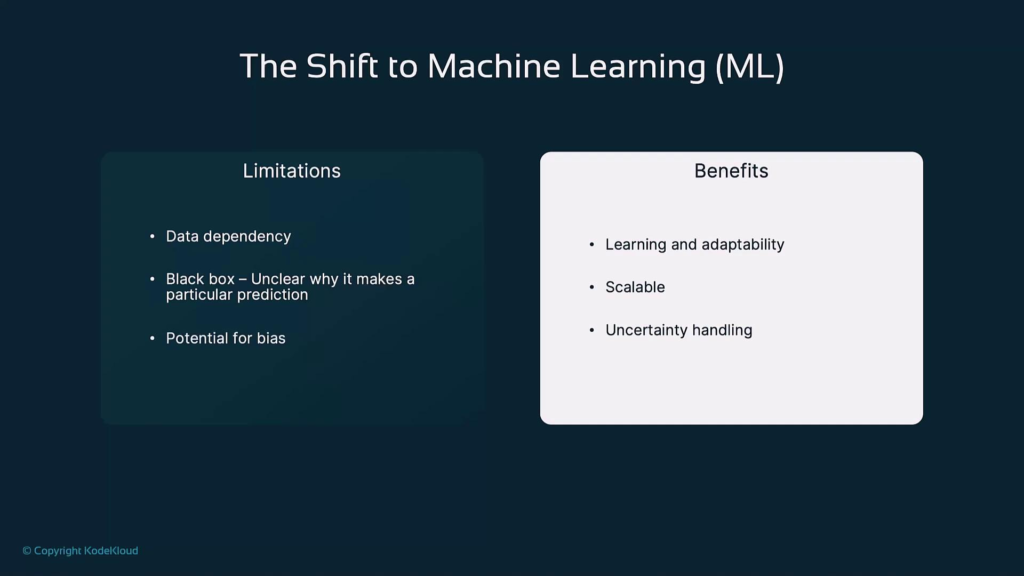
Situated firmly inside the broad canopy of AI lies Machine Learning, which represents a fundamental shift in how human software engineers instruct computing hardware. In traditional software development, a human programmer writes highly explicit code containing fixed mathematical instructions to convert specific data inputs into a predictable output. In contrast, Machine Learning turns this development pipeline upside down. Instead of requiring human engineers to manually program every microscopic decision rule, data scientists feed massive quantities of structural data into a generalized mathematical algorithm and allow the system to independently identify hidden patterns, extract core statistical relationships, and build its own predictive logic.
[Traditional Programming: Data + Human-Written Rules ➔ Fixed Program Output]
                             ▼
[Machine Learning Era: Data + Target Outcomes ➔ Algorithm Learns the Rules]
This structural framework enables Machine Learning models to continuously optimize their accuracy and refine their operational performance over time without needing manual code adjustments. When a popular media streaming network instantly recommends a television series aligned with your tastes, or an online retail platform presents products matched to your consumer persona, a Machine Learning engine is operating behind the interface. The algorithm continuously analyzes your historical browsing patterns, click velocities, and purchasing choices, contrasting your datasets against millions of other consumer vectors to build a hyper-customized predictive profile of what actions you are likely to take next.
Deep Learning: Scaling Up with Artificial Neural Networks
Positioned at the deep core of this architectural nesting is Deep Learning, which stands as a highly specialized, intensely mathematical subset of machine learning. The definitive characteristic that separates Deep Learning from broader machine learning techniques is the structural utilization of artificial neural networks. These intricate software designs are loosely inspired by the biological pathways, synaptic connections, and neuronal arrangements found within the human brain’s cerebral cortex.
The “deep” in Deep Learning is not a reference to philosophical profundity; rather, it refers to the literal structural depth of the network’s code. These software systems pass data through multiple vertical stacks of interconnected processing nodes, known technically as hidden layers.
[Raw Input Layer] ➔ [Hidden Layer 1: Edges] ➔ [Hidden Layer 2: Shapes] ➔ [Hidden Layer 3: Features] ➔ [Output Prediction]
While a basic machine learning model might contain only one or two data-transformation layers, a contemporary Deep Learning architecture can feature dozens, or even hundreds, of computational layers. This profound architectural complexity allows the network to automatically process massive, unstructured data matrices—such as raw video pixels, uncompressed audio waves, or disorganized blocks of text—without requiring a human data engineer to manually isolate specific features first. Deep Learning serves as the primary mathematical foundation enabling contemporary breakthroughs like fluid real-time speech translation, multi-object computer vision, autonomous vehicle control systems, and the conversational generative AI platforms transforming modern enterprise operations.
Architectural Divergence: Traditional ML vs. Deep Learning
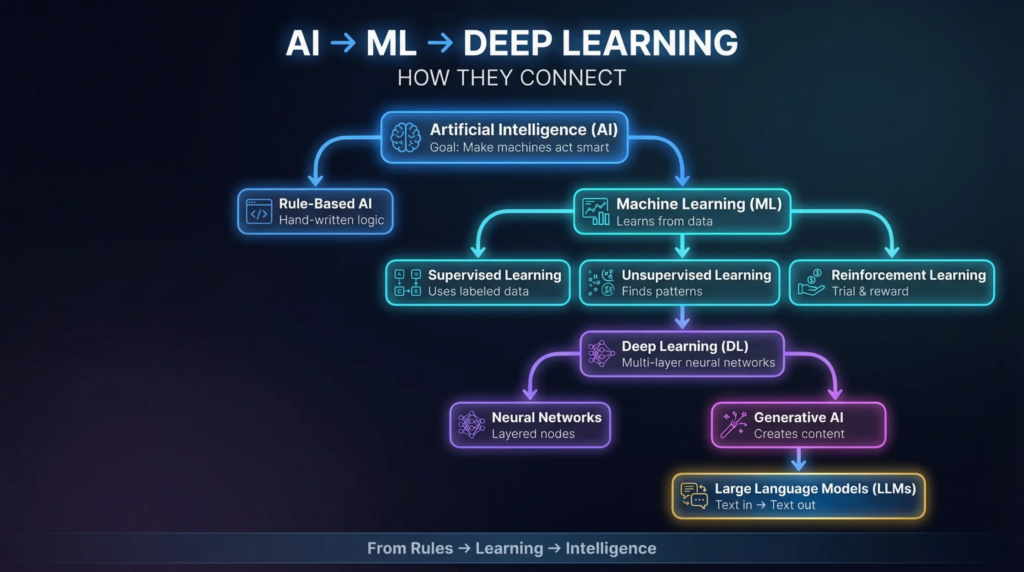
To properly appreciate why these systems require entirely different operational environments, one must look at how they approach data feature extraction. In a traditional Machine Learning workflow, human engineers must act as domain experts, performing a manual task known as feature engineering. If you want a standard ML model to categorize images of automobiles versus motorcycles, a human developer must write explicit statistical filters to look for specific structural shapes, wheel counts, or edge ratios. The algorithm then processes those hand-curated features to make a mathematical prediction.
Conversely, Deep Learning neural networks completely bypass this human-dependent phase. When you stream raw image files into a deep neural architecture, the initial hidden layers analyze simple mathematical contrasts, like pixel gradients and edge vectors. As the data flows deeper into the hidden layers, the network independently synthesizes those simple lines into complex geometric shapes, eventually mapping out full visual objects like tires, windshields, and handlebars. This capacity for autonomous feature extraction allows deep learning models to achieve levels of predictive accuracy that traditional software cannot match, but it comes at a steep cost: these systems demand massive, highly curated training datasets and require specialized, high-consumption GPU computing hardware to run their millions of simultaneous matrix multiplications.
Real-World Industrial Case Studies
The strategic blending of AI, ML, and DL frameworks is driving structural transformations across nearly every major sector of global industry, redefining operational speeds and changing how organizations create economic value.
| Business Industry | Core AI Function | Machine Learning Element | Deep Learning Element |
| Healthcare Diagnostics | Automated patient triage & scheduling | Regression models forecasting hospital readmission risks | Convolutional Neural Nets diagnosing tumors from raw MRI scans |
| Enterprise Finance | Automated customer support & risk management | Fraud detection models identifying anomalous transaction velocities | Natural Language Processing models parsing complex regulatory compliance docs |
| Autonomous Logistics | Fleet path optimization & traffic routing | Predictive algorithms forecasting parts maintenance lifecycles | Computer vision networks tracking real-time road obstacles and pedestrians |
The Symbiotic Synthesis: How the Pillars Work Together
In high-performance corporate environments and cutting-edge software deployments, these three technological tiers do not live in isolation; rather, they operate as a symbiotic computational stack to solve complex, multi-dimensional challenges.
Step-by-Step Data Flow in a Facial Recognition Security Environment
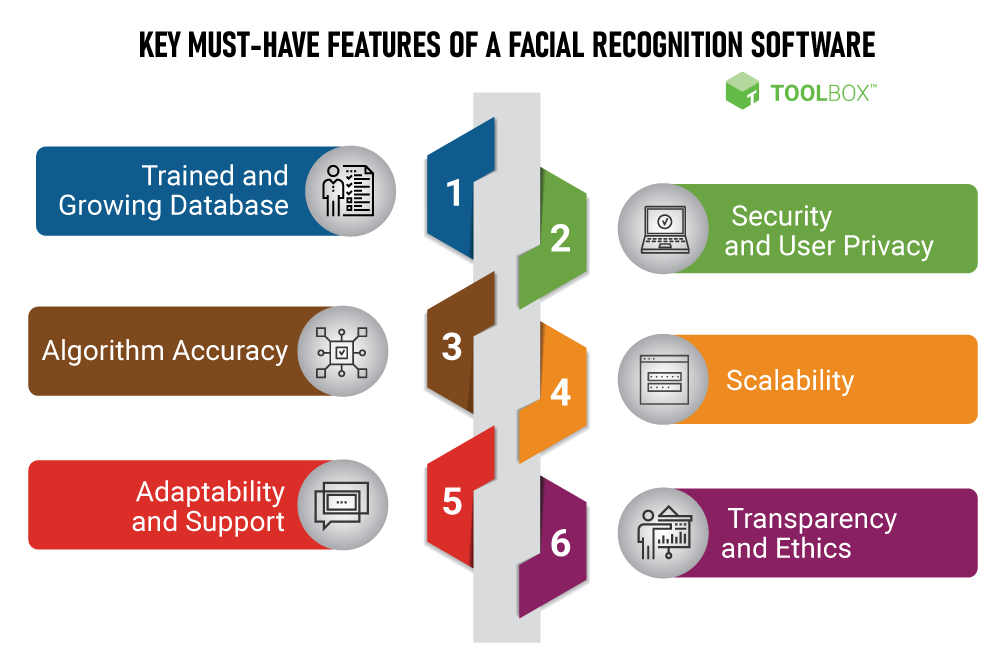
1.AI Macro-Framework Orchestration:Phase 1: System Activation.
The high-level AI environment monitors sensor inputs, activates cameras upon detecting motion, and initializes the security workflow.
2.Deep Learning Neural Feature Extraction:Phase 2: Feature Mapping.
A deep Convolutional Neural Network (CNN) parses the raw camera pixels, automatically isolating facial geometry, eye distances, and skin textures.
3.Machine Learning Predictive Matching:Phase 3: Classification.
The extracted facial vectors are processed by a machine learning classification model to contrast the identity against an active security database.
4.AI Operational Decision Output:Phase 4: Action Execution.
The overarching AI layer evaluates the match confidence score, executing the ultimate decision to either grant physical door access or trigger a silent security alert.
Primary Benefits of Adopting Intelligent Architectures
Global economic research indicates that enterprises integrating deep automation and predictive analytics into their operational workflows realize a 40% increase in operational efficiency and scale new product development cycles three times faster than legacy competitors.
- Scalable Task Automation: Shifting repetitive, intellectually tedious data management tasks away from human teams and assigning them to autonomous software systems lowers long-term overhead costs.
- Rapid Processing of Massive Datasets: Deep learning models crunch terabytes of unstructured enterprise data in fractions of a second, unlocking hidden business insights that would take human analyst teams months to extract.
- Hyper-Personalized Consumer Connections: Digital platforms leverage machine learning systems to serve consumers context-specific content, ads, and product options, drastically boosting user engagement and retention.
- Predictive Maintenance and Risk Prevention: Heavy industries deploy intelligent sensor networks to identify equipment degradation patterns before hardware failures happen, preventing catastrophic operational downtime.
Navigating Strategic Hurdles and Ethical Constraints

The rapid, unregulated proliferation of incredibly powerful cognitive computing systems presents serious ethical dilemmas, technical limitations, and societal risks that organizations must actively manage.
The most prominent technical hurdle inside deep neural networks is the black box dilemma. Because a deep learning model alters millions of mathematical parameters across hundreds of hidden layers simultaneously, it is often mathematically impossible for human software engineers to trace the precise logic behind a specific output. If an AI system denies an applicant a financial loan, or misdiagnoses a medical condition, determining the exact root cause of that computational failure becomes exceptionally difficult. Furthermore, if the historical datasets used to train these models contain deep human prejudices or skewed demographic balances, the intelligent system will automatically internalize, amplify, and codify those systemic biases, leading to highly unfair and discriminatory automated outcomes.
The Evolution of Intelligent Systems
Looking forward, the development trajectory of intelligent technologies points directly toward the realization of Multimodal Artificial Intelligence and highly integrated edge computing. Tomorrow’s systems will move beyond specialized single-task tools, evolving into deeply fluid, multi-sensory cognitive partners capable of processing text, voice, live video, and spatial physics data simultaneously.
Concurrently, the industry is witnessing a massive push toward Edge AI. This paradigm shifts complex machine learning and deep learning models away from centralized, distant cloud data centers and runs them directly on local physical hardware, such as smartphones, consumer appliances, and industrial field sensors. By eliminating the latency and security vulnerabilities associated with sending sensitive data across external networks, Edge AI will unlock split-second processing speeds, laying the foundations for fully autonomous robotic manufacturing, hyper-responsive smart cities, and next-generation medical devices that function completely independently of a stable internet connection.
By viewing AI as the overarching vision of computational human cognition, ML as the data-driven statistical engine that allows software to adapt without explicit programming, and DL as the multi-layered neural architecture built to unlock the deepest patterns hidden within unstructured data, we can better understand the true mechanics of digital transformation. As these technologies continue to converge, iterate, and integrate into our daily routines, they will redefine the limits of human productivity and permanently alter how humanity collaborates with intelligent machines.
Frequently Asked Questions
What is the most basic distinction between AI, ML, and Deep Learning?
Artificial Intelligence represents the broad conceptual goal of making computing systems mimic human intelligence. Machine Learning is a specific approach within AI focused on building models that independently learn patterns from historical data. Deep Learning is a highly specialized subset of Machine Learning that uses multi-layered artificial neural networks to process complex, unstructured data structures.
Can an elite AI software system run effectively without utilizing Machine Learning?
Yes, an AI system can operate entirely without machine learning algorithms. Early AI platforms, such as standard expert systems and digital chess engines, relied completely on extensive, human-written rule systems and hardcoded logic models rather than learning patterns from external data feeds.
Why do Deep Learning models require vastly larger training datasets than traditional ML?
Because deep neural networks contain millions of uncalibrated mathematical parameters across numerous hidden layers. To accurately fine-tune these complex mathematical connections and prevent the system from drawing incorrect conclusions, the model must process massive volumes of diverse data examples.
What is the primary difference between a hidden layer and a feature extraction process?
A hidden layer is an internal structural stack of processing nodes inside an artificial neural network. Feature extraction is the computational process of identifying specific traits or statistical markers within a dataset. In traditional machine learning, humans handle feature extraction manually, whereas in deep learning, the network’s hidden layers execute feature extraction automatically.
How does algorithmic bias manifest inside a deep neural network?
Intelligent systems have no inherent moral compass; they learn entirely by studying past data patterns. If the historical training data fed into an algorithm reflects human prejudices, contains demographic exclusions, or mirrors unfair historical decisions, the neural model will codify those patterns as objective logic, automatedly outputting biased results.