Artificial intelligence is transforming the way people work, learn, create, and communicate. From writing engaging content and designing stunning visuals to analyzing information and automating repetitive tasks, AI tools are becoming valuable digital companions in everyday life. What once required hours of manual effort can now be completed more efficiently with the help of intelligent applications.
In 2026, AI tools are no longer limited to technology experts or large organizations. Students, creators, freelancers, marketers, business owners, developers, and professionals are exploring AI-powered platforms to improve productivity and simplify complex activities. These tools can help users generate ideas, summarize documents, create presentations, edit videos, write code, and discover new ways to solve problems.
The growing popularity of AI tools is driven by accessibility, versatility, and continuous innovation. Many platforms provide user-friendly interfaces that allow people to interact with artificial intelligence through simple text prompts, uploaded files, voice commands, or visual inputs.
However, choosing the right AI tool is equally important. Different applications are designed for different purposes, and understanding their capabilities can help users avoid unnecessary subscriptions while achieving better results.
This guide explores popular categories of AI tools, their practical uses, important benefits, and how to select the right solution for your digital needs.
AI Writing Tools: Create Better Content Faster
<AsyncImage query=”AI writing assistant laptop content creator writing digital article modern workspace” aspectRatio=”16:9″ width=”100%”/>
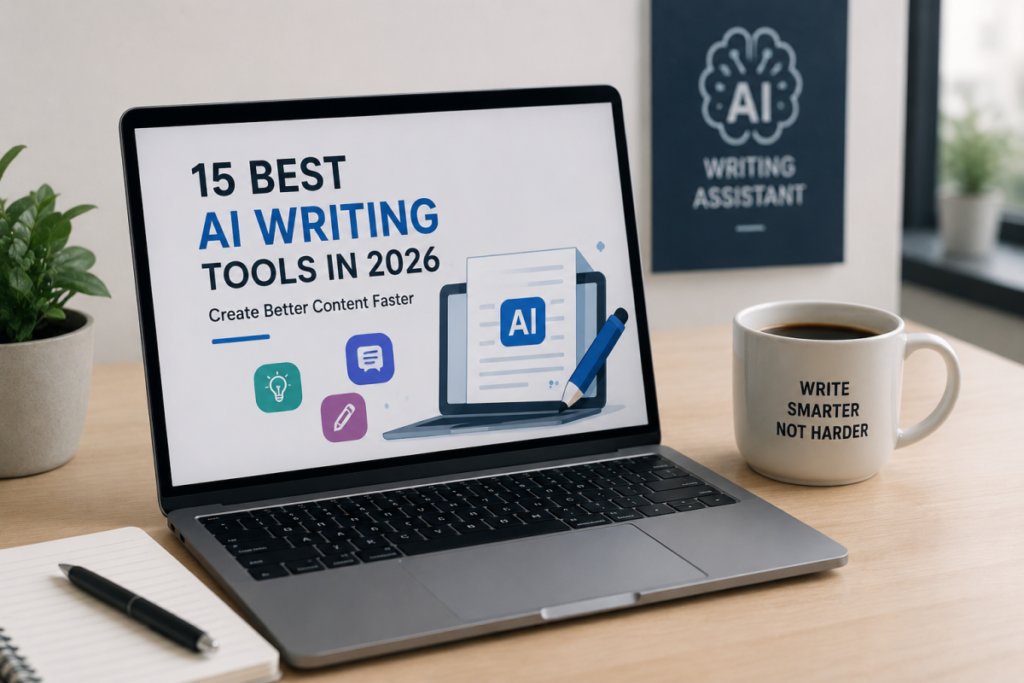
AI writing tools are among the most widely used artificial intelligence applications. They help users develop ideas, prepare drafts, improve grammar, rewrite sentences, and organize information into readable content.
These tools can be particularly useful for bloggers, digital marketers, students, business professionals, and social media creators who regularly produce written material.
Instead of starting with a blank page, users can provide a topic, audience, tone, and objective to generate an initial draft. The result can then be edited to improve accuracy, clarity, originality, and personal style.
Popular AI writing tools:
- <Entity value=”ChatGPT” category=”software”/> – Helps with writing, brainstorming, explanations, and content development.
- <Entity value=”Claude” category=”software”/> – Useful for drafting, editing, and working with lengthy text.
- <Entity value=”Grammarly” category=”software”/> – Supports grammar, clarity, and writing improvements.
- <Entity value=”Jasper” category=”software”/> – Provides AI-assisted marketing and brand content workflows.
- <Entity value=”Copy.ai” category=”software”/> – Supports marketing copy and business content generation.
How AI Writing Tools Can Improve Content Creation
AI writing applications can help organize ideas into structured sections, suggest suitable headings, and adapt content to different audiences.
For example, a blogger preparing an article about productivity can use an AI assistant to brainstorm topics, create an outline, draft FAQs, and identify areas that need further research.
Important pointers:
- Use specific prompts for better results.
- Provide context about your audience.
- Review facts before publishing.
- Avoid publishing unedited AI-generated content.
- Maintain your own writing style and originality.
AI Image Generation Tools: Turn Ideas Into Visuals

<AsyncImage query=”AI generated digital artwork colorful futuristic creative illustration computer screen” aspectRatio=”16:9″ width=”100%”/>
AI image generation tools allow users to transform written descriptions into visual content. They can create illustrations, concept art, product-style visuals, social media graphics, and creative design ideas.
These applications are useful for designers, bloggers, advertisers, content creators, and individuals who want to explore visual creativity without beginning every project from scratch.
Some popular AI image tools include:
- <Entity value=”Midjourney” category=”software”/> – Known for artistic and stylized image generation.
- <Entity value=”Adobe Firefly” category=”software”/> – Supports creative image generation and editing workflows.
- <Entity value=”DALL·E” category=”software”/> – Helps generate images from descriptive prompts.
- <Entity value=”Leonardo AI” category=”software”/> – Offers creative image generation and visual design capabilities.
- <Entity value=”Canva AI” category=”software”/> – Integrates AI-assisted design features into a broader design platform.
Tips for Creating Better AI Images
The quality of an AI-generated image often depends on how clearly the prompt describes the intended result.
A useful prompt may include:
- The main subject.
- The visual style.
- Lighting and atmosphere.
- Background details.
- Image composition.
- Intended use, such as a blog thumbnail or social media post.
For example, instead of writing “modern kitchen,” a more descriptive prompt could specify a bright minimalist kitchen with natural lighting, wooden cabinets, clean countertops, and a realistic interior photography style.
AI-generated images should also be reviewed for visual errors, inaccurate details, and possible licensing restrictions before commercial use.
AI Video Tools: Simplify Video Creation and Editing
<AsyncImage query=”AI video editing software timeline digital content creator desktop workstation” aspectRatio=”16:9″ width=”100%”/>
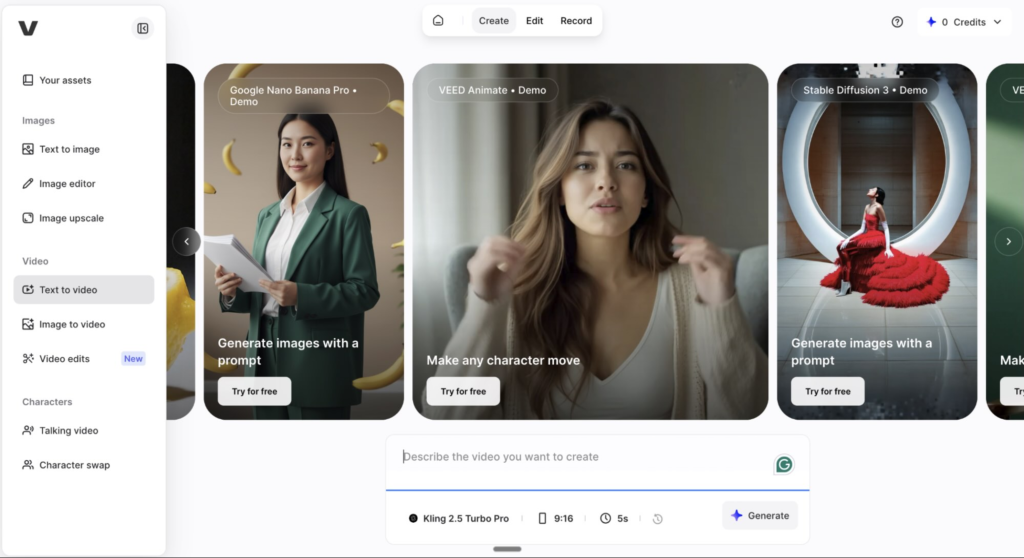
Video content is becoming increasingly important across social media, education, marketing, and online communication. AI video tools help users simplify different stages of video production, including editing, captioning, voiceovers, scene generation, and content repurposing.
Creators who produce short-form videos can use AI-assisted workflows to develop scripts, generate subtitles, improve audio, and adapt longer videos into shorter clips.
Popular AI video tools:
- <Entity value=”Runway” category=”software”/> – Provides AI-powered video generation and creative editing features.
- <Entity value=”Pika” category=”software”/> – Supports AI video creation from prompts and visual inputs.
- <Entity value=”Synthesia” category=”software”/> – Offers avatar-based video creation for presentations and training.
- <Entity value=”CapCut” category=”software”/> – Provides accessible video editing with AI-assisted features.
- <Entity value=”Descript” category=”software”/> – Helps edit audio and video through text-based workflows.
AI video tools can reduce the complexity of production, but creative direction, storytelling, and final editing remain important for producing engaging videos.
AI Productivity Tools: Work Smarter, Not Harder

AI productivity tools are designed to help individuals and teams manage their time, organize tasks, and improve workflow efficiency. They can support activities such as meeting summaries, task planning, document management, email drafting, and information organization.
For professionals handling multiple responsibilities, these tools can reduce repetitive work and make daily tasks easier to manage.
Popular AI Productivity Applications
- Notion AI – Helps organize notes, documents, and workspace information.
- Microsoft Copilot – Supports productivity workflows across compatible Microsoft applications.
- Google Gemini – Offers AI assistance for research, writing, and supported Google workflows.
- Otter.ai – Supports meeting transcription and summaries.
- Perplexity – Helps users research questions with source-linked responses.
Everyday Tasks AI Productivity Tools Can Simplify
| Task | AI-powered assistance |
|---|---|
| Email writing | Drafting professional messages |
| Meeting management | Creating summaries and action points |
| Task planning | Organizing priorities |
| Note-taking | Summarizing important information |
| Research | Finding and organizing relevant sources |
| Content planning | Developing ideas and schedules |
The best productivity tools are those that fit naturally into existing workflows. Users should evaluate whether an application genuinely saves time instead of adding unnecessary complexity.
AI Research Tools: Discover Information More Efficiently

Research is an essential part of education, content creation, business planning, and professional decision-making. AI research tools can help users explore topics, summarize documents, identify relevant sources, and organize information.
These tools are especially helpful when working with large amounts of information. Instead of manually reviewing every document from the beginning, users may be able to obtain summaries and identify sections that deserve closer attention.
Useful AI research applications include:
- NotebookLM – Helps analyze and summarize user-provided sources.
- Elicit – Supports research workflows involving scientific literature.
- Perplexity – Helps explore questions and provides cited web-based responses.
- Consensus – Helps discover findings from research papers.
Important Research Pointers
- Check the original source before relying on a claim.
- Verify dates and statistics.
- Compare information from multiple sources.
- Avoid treating AI summaries as complete replacements for original documents.
- Use trusted sources for academic and professional research.
AI can accelerate research, but critical thinking and source verification remain essential.
AI Education Tools: Make Learning More Interactive

Artificial intelligence is creating new opportunities for personalized learning. Students can use AI applications to understand complex concepts, practise questions, organize study materials, and explore subjects at their own pace.
AI education tools can also help teachers prepare lesson plans, create educational resources, and explain topics through different approaches.
Popular AI learning tools:
- Khanmigo – Provides AI-supported educational assistance.
- Quizlet – Supports learning through flashcards and study activities.
- Duolingo – Offers language-learning experiences with technology-supported features.
- ChatGPT – Can explain concepts, generate practice questions, and assist with studying.
- Photomath – Helps learners understand mathematical problems.
How Students Can Use AI Responsibly
AI should be used as a learning companion rather than a shortcut for completing every assignment.
Students can ask AI to explain difficult topics in simple language, provide examples, create revision questions, or identify gaps in their understanding.
The most effective approach combines AI assistance with independent practice, classroom learning, and critical thinking.
AI Coding Tools: Support Developers and Beginners

AI coding tools are changing software development by helping programmers write, understand, debug, and improve code. These applications can suggest code snippets, explain programming concepts, generate test cases, and assist with documentation.
They can also make programming more approachable for beginners who are learning languages such as Python, JavaScript, HTML, and CSS.
Popular AI coding tools:
- GitHub Copilot – Provides AI-assisted coding suggestions.
- Cursor – Offers an AI-focused coding environment.
- Replit AI – Supports AI-assisted development within Replit.
- Codeium – Provides AI-powered coding assistance.
- Amazon Q Developer – Supports software development workflows.
| Coding activity | How AI can help |
|---|---|
| Code generation | Suggest code based on instructions |
| Debugging | Identify potential errors |
| Learning programming | Explain code in simpler terms |
| Documentation | Draft descriptions of functions |
| Testing | Suggest test cases |
| Code improvement | Recommend readability enhancements |
AI-generated code should always be reviewed, tested, and checked for security vulnerabilities before being used in production.
AI Voice and Audio Tools: Transform the Way We Communicate
AI voice and audio tools are gaining popularity among creators, educators, podcasters, and businesses. They can convert text into speech, improve audio quality, generate voiceovers, and assist with transcription.
These tools are particularly useful for video creators who need narration without recording every line manually.
Some popular applications include:
- ElevenLabs – Offers AI voice generation and audio capabilities.
- Suno – Supports AI-assisted music creation.
- Adobe Podcast – Provides AI-assisted audio enhancement.
- Murf AI – Offers AI voiceover generation.
- Speechify – Converts written content into spoken audio.
Practical applications:
- Creating video narration.
- Producing educational audio.
- Improving podcast recordings.
- Converting articles into audio.
- Supporting accessibility through speech technology.
Always respect voice ownership, consent, and applicable licensing rules when generating or cloning voices.
AI Marketing Tools: Improve Digital Marketing Strategies

<AsyncImage query=”AI digital marketing analytics dashboard social media campaign laptop workspace” aspectRatio=”16:9″ width=”100%”/>
Digital marketing is becoming more data-driven, and AI tools are helping marketers develop content, understand audiences, analyze campaign performance, and improve customer engagement.
From blog writing and keyword research to social media planning and email campaigns, AI applications can support multiple stages of marketing.
Popular AI marketing tools:
- <Entity value=”HubSpot AI” category=”software”/> – Supports marketing, sales, and customer relationship workflows.
- <Entity value=”Surfer SEO” category=”software”/> – Helps with content optimization.
- <Entity value=”Semrush” category=”software”/> – Offers SEO and digital marketing research tools.
- <Entity value=”Canva” category=”software”/> – Supports visual marketing content creation.
- <Entity value=”Jasper” category=”software”/> – Assists with marketing copy and brand content.
AI Marketing Applications
| Marketing activity | AI application |
|---|---|
| SEO content | Content optimization and topic planning |
| Social media | Caption and content idea generation |
| Email campaigns | Drafting personalized messages |
| Customer support | Automated response assistance |
| Analytics | Summarizing campaign data |
| Advertising | Supporting creative development |
AI can improve marketing efficiency, but successful campaigns still require audience understanding, creativity, strategic planning, and human judgment.
Benefits and Limitations of AI Tools
AI tools offer several advantages, but users should also understand their limitations before relying on them.
Major Benefits of AI Tools
1. Increased productivity: AI can help complete repetitive tasks more quickly.
2. Improved creativity: AI applications can suggest fresh ideas, designs, and content approaches.
3. Accessibility: Many tools are easy to use without advanced technical knowledge.
4. Better organization: AI can help summarize information and manage digital workflows.
5. Learning opportunities: AI assistants can explain concepts and support skill development.
6. Workflow automation: Selected tasks can be connected and automated through AI-powered systems.
Limitations to Consider
- AI-generated information may contain errors.
- Some advanced features require paid subscriptions.
- Sensitive information may create privacy risks.
- Generated content may require substantial editing.
- AI outputs may reflect biases in their training data.
- Copyright, ownership, and licensing considerations may apply.
AI tools should be treated as assistants rather than infallible decision-makers.
How to Choose the Right AI Tool
With hundreds of AI applications available, selecting the right tool can feel overwhelming. The best choice depends on your goals, budget, technical experience, and the type of work you want to complete.
Before selecting a platform, consider the following factors:
| Selection factor | What to evaluate |
|---|---|
| Purpose | Does the tool solve your actual problem? |
| Pricing | Is a free plan available? |
| Ease of use | Is the interface beginner-friendly? |
| Features | Does it provide the capabilities you need? |
| Accuracy | Are its outputs reliable for your intended use? |
| Privacy | How does it handle uploaded information? |
| Integrations | Does it work with your existing applications? |
| Limitations | Are usage limits or restrictions clearly explained? |
Free AI Tools vs Paid AI Tools
Free AI tools can be suitable for beginners, students, and individuals exploring artificial intelligence. They often provide basic features that are sufficient for everyday tasks.
Paid tools may offer higher usage limits, advanced capabilities, additional integrations, or professional workflows.
| Free AI tools | Paid AI tools |
|---|---|
| Suitable for basic tasks | Suitable for advanced workflows |
| Usually have usage limits | May provide higher limits |
| Good for experimentation | Often include premium features |
| Lower financial commitment | Require subscription or payment |
| May have fewer integrations | May offer broader integrations |
A paid subscription is not automatically better. Start by identifying your requirements and testing available options.
The Future of AI Tools in 2026 and Beyond
Artificial intelligence is moving toward more integrated, personalized, and task-oriented experiences. Instead of using separate applications for every activity, users may increasingly rely on AI assistants that connect multiple workflows.
Emerging developments include AI agents, multimodal assistants, AI-powered automation, personalized learning systems, and intelligent business applications.
These technologies may help users perform more complex tasks by combining text, images, audio, data, and software interactions.
However, the future of AI will also depend on responsible development, transparency, security, and human oversight.
As AI continues evolving, the most valuable tools will not necessarily be the ones with the largest number of features. They will be the ones that solve real problems, improve efficiency, and provide dependable experiences.
- AI Tools 2026: Transform Work With Smart Technology
- AI in Daily Life 2026: Smarter Living With Artificial Intelligence
- AI Tools 2026: Explore the Future of Smart Digital Productivity
- Understanding Artificial Intelligence from the Basics
- AI Ethics: Building a Responsible Future With Artificial Intelligence
Frequently Asked Questions (FAQs)
1. What are AI tools?
AI tools are software applications that use artificial intelligence to perform tasks such as writing, research, image generation, coding, data analysis, and automation.
2. Which AI tools are best for beginners?
ChatGPT, Canva AI, Grammarly, Google Gemini, and NotebookLM are useful starting points for exploring different AI capabilities.
3. Are AI tools available for free?
Yes. Many AI applications offer free plans or limited free features. Availability and usage limits vary by platform.
4. Can AI tools help with content creation?
Yes. AI tools can assist with brainstorming, writing drafts, generating visuals, editing content, and preparing social media materials.
5. Can AI tools replace human creativity?
AI can support creative processes, but human judgment, originality, storytelling, and emotional understanding remain important.