
Artificial Intelligence (AI) Understanding is transforming the way people work, learn, communicate, and interact with technology. From voice assistants and smart recommendations to automated business operations and advanced content creation, AI has become an important part of everyday digital experiences. What once seemed like a futuristic concept is now helping individuals and organisations solve problems, make informed decisions, and complete tasks more efficiently.
As AI continues to develop, understanding its fundamentals is becoming an essential digital skill. You do not need to be a programmer, data scientist, or technology expert to understand how artificial intelligence works. Learning its basic concepts, applications, benefits, and limitations can help you recognise where AI is useful and how to use it responsibly.
In 2026, AI is no longer limited to specialised research laboratories. Students use AI-powered learning assistants, businesses explore intelligent automation, creators experiment with AI-generated content, and professionals use intelligent tools to organise their workflows. These developments make AI knowledge valuable across different industries and everyday activities.
Whether you are completely new to artificial intelligence or looking to strengthen your existing knowledge, understanding its foundations can help you explore emerging technologies with greater confidence.
What Is Artificial Intelligence?

Artificial Intelligence refers to the development of computer systems that can perform tasks commonly associated with human intelligence. These tasks include recognising patterns, understanding language, analysing information, making predictions, generating content, and supporting decision-making.
Traditional computer programs generally follow predefined instructions. AI systems, particularly those based on machine learning, can learn patterns from data and use them to produce predictions or responses.
For example, when a music streaming application recommends songs based on your listening habits, AI may be analysing your previous activity and comparing it with patterns from other users.
Similarly, an AI-powered writing assistant can process a prompt, understand its context, and generate a relevant response.
In simple terms: Artificial Intelligence enables machines to process information and perform certain tasks in ways that resemble aspects of human intelligence.
How Does Artificial Intelligence Work?

AI systems work through a combination of data, algorithms, computing power, and mathematical models. The exact process depends on the type of AI technology being used, but most modern machine learning systems follow a general learning and prediction process.
1. Data Collection
AI systems need information to identify patterns and perform specific tasks. This information may include text, images, audio, videos, numerical records, or other digital inputs.
For example, an image recognition system may be trained using thousands of labelled photographs to identify objects such as vehicles, animals, and everyday products.
2. Data Processing
Before information can be used effectively, it may need to be organised, cleaned, and prepared. This helps improve data quality and reduces errors that could affect the system’s performance.
3. Model Training
During training, machine learning algorithms analyse examples and identify patterns. The model adjusts its internal parameters to improve its ability to perform a particular task.
4. Prediction and Output
Once trained, the model can process new information and generate an output. Depending on its purpose, this could be a recommendation, classification, prediction, written response, or generated image.
5. Evaluation and Improvement
AI models are evaluated to understand how accurately they perform. Developers use testing, feedback, and updated training methods to identify weaknesses and improve performance.
Example: An email filtering system learns patterns associated with unwanted messages and uses them to classify incoming emails as spam or legitimate.
Different Types of Artificial Intelligence
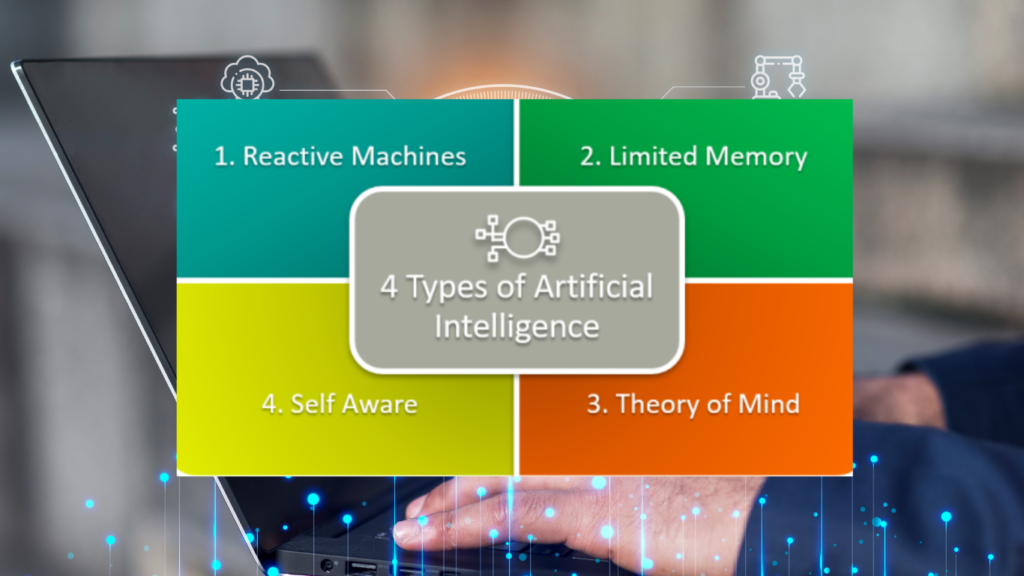
AI can be classified in different ways, including according to its capabilities and the technologies used to develop it. Understanding these categories makes the subject easier to explore.
AI Based on Capabilities
| Type of AI | Description | Current Status |
|---|---|---|
| Narrow AI | Designed for specific tasks | Widely used today |
| General AI (AGI) | Would perform a broad range of intellectual tasks at human-like levels | Not achieved |
| Super AI | Hypothetical intelligence exceeding human capabilities across domains | Theoretical concept |
Narrow AI: Most artificial intelligence applications available today belong to this category. Examples include voice recognition, recommendation engines, translation tools, and image classification systems.
Artificial General Intelligence: AGI refers to a hypothetical form of AI capable of understanding and performing a wide variety of intellectual tasks at a general level comparable to humans. It has not been established as an achieved technology.
Super AI: This is a theoretical concept describing an AI system that would surpass human intelligence across many areas. It remains a subject of scientific and philosophical discussion.
AI Based on Technology
Different technologies help AI systems process information, identify patterns, and generate results.
| Technology | What It Does | Example |
|---|---|---|
| Machine Learning | Learns patterns from data | Product recommendations |
| Deep Learning | Uses multi-layer neural networks | Image recognition |
| Natural Language Processing | Processes human language | Chatbots and translation |
| Computer Vision | Analyses visual information | Facial and object detection |
| Generative AI | Creates new content | Text and image generation |
| Reinforcement Learning | Learns through actions and feedback | Game-playing systems |
Important AI Fundamentals Everyone Should Know
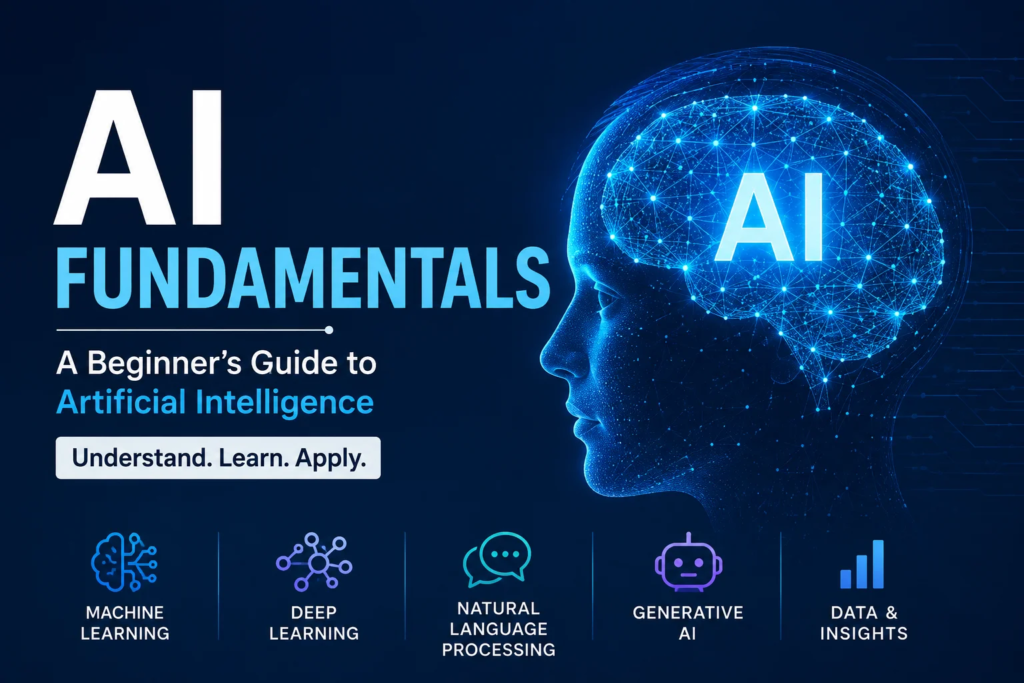
Before exploring advanced AI tools, it is useful to understand some essential concepts that explain how modern artificial intelligence operates.
1. Machine Learning
Machine Learning (ML) is a branch of AI that allows computer systems to learn patterns from data rather than relying entirely on manually written rules.
For example, an online shopping platform may analyse previous purchases and browsing behaviour to recommend products that match a customer’s interests.
Machine learning is commonly used in fraud detection, forecasting, recommendation systems, and predictive analytics.
2. Deep Learning
Deep Learning is a specialised area of machine learning that uses artificial neural networks with multiple processing layers.
These networks can identify complex patterns in large datasets. Deep learning plays an important role in speech recognition, image analysis, language models, and advanced AI applications.
3. Natural Language Processing (NLP)
Natural Language Processing helps computers understand, interpret, and generate human language.
It supports applications such as language translation, text summarisation, chatbots, sentiment analysis, and voice assistants.
For example, when you ask an AI assistant to summarize a long document, NLP technologies help the system process the language and produce a shorter explanation.
4. Generative AI
Generative AI refers to systems that can create new content based on patterns learned during training.
These systems can generate written content, images, audio, videos, computer code, and other forms of digital output.
Popular applications include AI writing assistants, image generators, coding assistants, and music-generation tools.
5. Large Language Models (LLMs)
Large Language Models are AI models trained on extensive collections of text and other language-related data. They can generate responses, summarize information, answer questions, and assist with writing and coding tasks.
Understanding these concepts provides a strong foundation for exploring modern AI applications.
Popular AI Tools and Their Applications
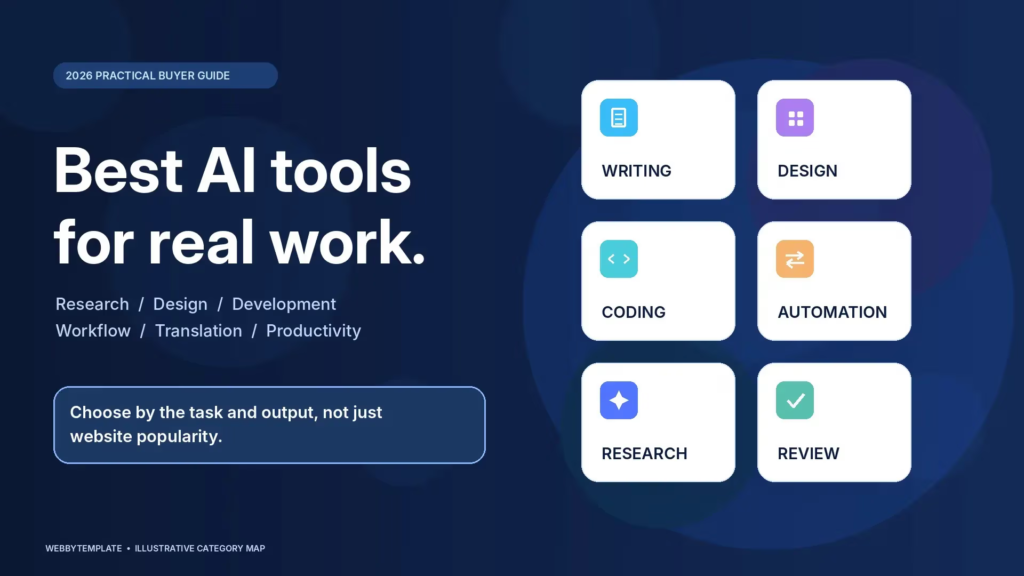
AI tools are making advanced technology accessible to people without specialised technical knowledge. Many platforms provide simple interfaces that allow users to generate content, analyse information, create designs, and automate repetitive activities.
Here are some popular AI tools and their primary uses.
| AI Tool | Main Purpose | Suitable For |
|---|---|---|
| ChatGPT | AI conversations and content generation | Students, professionals, creators |
| Google Gemini | AI assistance and information processing | Research and productivity |
| Claude | Writing, reasoning, and document analysis | Professionals and writers |
| Midjourney | AI image generation | Designers and artists |
| Perplexity | AI-assisted research | Students and researchers |
| GitHub Copilot | AI-powered coding assistance | Developers |
| Canva | Design and AI-assisted creative workflows | Marketers and creators |
You can also explore AltFTool, a directory of AI tools and digital resources, to discover solutions for writing, designing, productivity, research, and other everyday tasks.
Real-World Applications of Artificial Intelligence

AI is no longer restricted to technology companies. It is being adopted across industries to improve efficiency, support decision-making, and introduce new ways of working.
1. AI in Education
Artificial intelligence is changing how students access information and understand difficult subjects. AI-powered learning assistants can explain concepts, generate practice questions, summarize notes, and support personalised learning.
Teachers can also use AI tools to prepare educational materials, organise lesson plans, and develop interactive learning activities.
However, students should use AI as a learning assistant rather than relying on it to complete every assignment.
2. AI in Healthcare
Healthcare organisations use AI technologies to support medical image analysis, research, administrative workflows, and certain clinical decision-support processes.
For example, specialised AI systems can help analyse medical images and identify patterns that healthcare professionals may investigate further. Medical decisions still require appropriate professional oversight.
3. AI in Business and Marketing
Businesses use AI to analyse customer behaviour, automate repetitive activities, improve marketing strategies, and understand market trends.
Marketing professionals can use AI-assisted tools to brainstorm campaign ideas, draft content, analyse performance, and organise customer communication.
4. AI in Finance
Financial institutions use AI for fraud detection, transaction monitoring, risk assessment, and customer service automation.
AI systems can identify unusual transaction patterns and flag potentially suspicious activities for further investigation.
5. AI in Everyday Life
Artificial intelligence is already present in many everyday applications.
Examples include:
- Voice assistants that respond to spoken commands.
- Navigation applications that estimate travel routes.
- Streaming platforms that recommend movies and music.
- Email services that filter spam messages.
- Smartphone cameras that automatically improve photographs.
- Shopping platforms that suggest relevant products.
Benefits of Artificial Intelligence
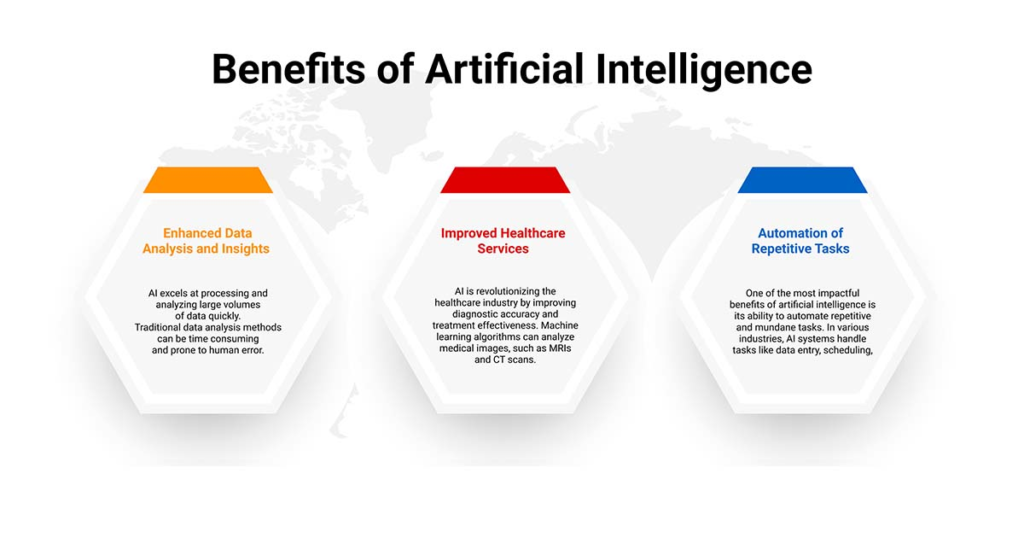
AI offers several advantages when implemented appropriately. Its ability to process information quickly and recognise patterns makes it valuable for individuals and organisations.
| Benefit | Explanation |
|---|---|
| Automation | Reduces repetitive manual activities. |
| Time Efficiency | Helps complete certain tasks faster. |
| Data Analysis | Identifies patterns in large datasets. |
| Personalisation | Supports customised recommendations. |
| Accessibility | Enables new ways to interact with digital services. |
| Productivity | Assists with writing, research, planning, and organisation. |
| Innovation | Creates opportunities for new products and services. |
Important advantages to remember:
- AI can help professionals focus on more meaningful activities.
- It can make digital services easier to access.
- It supports faster analysis of large amounts of information.
- It can assist people in exploring new ideas and creative possibilities.
- It can help businesses identify patterns and improve operational processes.
Challenges and Limitations of Artificial Intelligence

Despite its advantages, AI has limitations that users should understand before depending on its outputs.
1. Inaccurate Information: AI systems can generate incorrect answers or misleading explanations. Always verify important information.
2. Data Privacy: Some AI platforms process user-provided information. Avoid uploading confidential documents, passwords, or sensitive personal details without understanding the platform’s privacy practices.
3. Bias and Fairness: AI models can reproduce biases present in their training data, potentially producing unfair or unbalanced results.
4. Lack of Human Understanding: AI can generate convincing responses without possessing human experiences, emotions, or genuine understanding in the way people do.
5. Security Risks: AI can be misused to generate misleading content, automate harmful activities, or create convincing impersonations.
6. Employment Changes: Automation may change job responsibilities and reduce demand for certain repetitive tasks while creating new opportunities and skill requirements.
Responsible AI use requires human judgement, proper evaluation, and awareness of these limitations.
How to Start Learning Artificial Intelligence as a Beginner
You do not need advanced mathematics or programming knowledge to begin exploring AI. Starting with simple concepts and practical applications can make the learning process easier.
Here is a beginner-friendly learning roadmap.
Your AI Learning Roadmap
- Understand the basicsLearn what AI is, how it works, and where it is used.
- Explore machine learningUnderstand datasets, algorithms, training, and predictions.
- Experiment with AI toolsTry writing assistants, image generators, and research tools.
- Learn prompt writingPractise giving clear instructions to AI systems.
- Explore basic programmingLearn Python and introductory data concepts if you want to explore technical AI development.
- Build practical projectsCreate a simple chatbot, text classifier, or AI-assisted productivity project.
Essential Skills for Learning AI
| Skill | Why It Is Useful |
|---|---|
| Critical Thinking | Helps evaluate AI-generated information. |
| Data Literacy | Builds understanding of how data is used. |
| Problem-Solving | Helps identify practical AI applications. |
| Prompt Engineering | Improves communication with AI tools. |
| Basic Mathematics | Supports understanding of AI models. |
| Programming | Helps develop and customise AI applications. |
| Ethical Awareness | Encourages responsible technology use. |
Beginners can start with free educational resources, introductory courses, and hands-on experimentation. As their knowledge improves, they can explore more advanced subjects such as neural networks, model development, and data science.
The Future of Artificial Intelligence
Artificial intelligence is expected to continue influencing technology, education, business, entertainment, and everyday life. New developments are making AI systems more capable of processing different types of information and assisting with complex workflows.
Some important developments to watch include:
- Multimodal AI: Systems that can work with text, images, audio, and video together.
- AI Agents: Systems designed to complete multi-step tasks with varying levels of independence.
- Personalised AI: Assistants that adapt their responses to individual requirements and workflows.
- AI in Robotics: Combining intelligent software with physical machines to support real-world activities.
- Responsible AI Development: Greater attention to transparency, safety, privacy, and fairness.
- AI-powered Automation: More intelligent workflows across business operations and digital services.
As these technologies develop, understanding AI fundamentals will become increasingly useful. People who combine AI knowledge with creativity, communication, critical thinking, and domain expertise will be better prepared to adapt to changing digital environments.
- AI Tools 2026: Transform Work With Smart Technology
- AI in Daily Life 2026: Smarter Living With Artificial Intelligence
- AI Tools 2026: Explore the Future of Smart Digital Productivity
- Understanding Artificial Intelligence from the Basics
- AI Ethics: Building a Responsible Future With Artificial Intelligence
Frequently Asked Questions (FAQs)
1. What are AI fundamentals?
AI fundamentals are the basic concepts of artificial intelligence, including machine learning, deep learning, algorithms, data processing, and generative AI.
2. Can beginners learn artificial intelligence?
Yes. Beginners can start with basic AI concepts and simple online tools before exploring programming and advanced technical subjects.
3. What is the difference between AI and machine learning?
AI is the broader field of creating intelligent computer systems, while machine learning is a branch of AI that enables systems to learn patterns from data.
4. Is coding necessary to use AI tools?
No. Many AI applications have user-friendly interfaces that do not require coding. Programming becomes useful when developing or customising AI systems.
5. What are some examples of AI in everyday life?
Voice assistants, recommendation systems, spam filters, navigation applications, smart cameras, and AI chatbots are common examples.