
Artificial Intelligence AI Ethics is transforming the way people work, learn, communicate, shop, and make decisions. From chatbots and virtual assistants to facial recognition and automated hiring systems, AI has become an important part of modern life. It helps businesses save time, improves productivity, and makes complex tasks easier. However, as AI becomes more powerful, an important question arises: Are we using artificial intelligence responsibly?
This is where AI ethics comes into the picture. AI ethics focuses on developing and using artificial intelligence in ways that are fair, transparent, safe, accountable, and respectful of human rights. It ensures that technological progress does not come at the cost of privacy, equality, or public trust.
AI is not simply about creating smarter machines. It is also about making sure those machines make responsible decisions and benefit society. Whether someone is using AI to write content, analyse information, generate images, or manage business operations, understanding AI ethics is becoming increasingly important.
What Is AI Ethics?

AI ethics refers to the principles, guidelines, and practices that help ensure artificial intelligence systems are designed, developed, and used responsibly. It examines how AI affects individuals, organisations, communities, and society as a whole.
An AI system can process enormous amounts of information, identify patterns, and generate recommendations. However, its results are not automatically correct or fair. AI systems can produce inaccurate information, reflect biases in training data, or make decisions that are difficult for people to understand.
For example, imagine a company using AI to shortlist job applicants. If the system has been trained on biased historical hiring data, it may unfairly favour certain groups of candidates. This demonstrates why ethical considerations must be included throughout the AI development process.
AI ethics encourages developers, companies, governments, and users to think beyond performance and consider the wider impact of their technology.
Why Is AI Ethics Important?
As AI tools become part of everyday activities, their decisions can influence employment, education, healthcare, finance, and public services. Without proper safeguards, these systems may create risks that affect individuals and communities.
One major concern is fairness. AI should not discriminate against people because of their gender, background, age, or other personal characteristics. Another important issue is privacy, especially when AI systems collect and analyse personal information.
Transparency is equally important. People should understand when AI is being used and, where appropriate, how important decisions are made. Businesses also need clear accountability when their AI systems cause harm or produce misleading results.
Ethical AI is not just a technical responsibility. It is a shared responsibility involving developers, organisations, policymakers, and everyday users.
Core Principles of Ethical Artificial Intelligence
Responsible AI is built around several important principles. These principles guide organisations when creating AI products and help users understand what makes an AI system trustworthy.
1. Fairness and Bias Prevention
Fairness is one of the most important aspects of AI ethics. AI systems learn from data, and if that data contains historical inequalities or biased information, the system may repeat those patterns.
For example, an AI recruitment tool might unintentionally favour candidates with certain educational backgrounds because its training data reflects previous hiring preferences. Similarly, facial recognition technology may perform differently across demographic groups.
To reduce these risks, developers should use diverse datasets, regularly test their systems, and monitor outcomes for unfair patterns. Fairness should be considered from the beginning rather than added after a problem appears.
2. Data Privacy and Protection
AI systems often rely on large amounts of information to perform their tasks. This information may include personal details, browsing behaviour, photographs, business records, or other sensitive data.
Protecting this information is essential for maintaining user trust. Organisations should collect only the data they genuinely need, explain how it will be used, and apply appropriate security measures.
Users should also avoid sharing passwords, financial details, confidential business documents, or sensitive personal information with AI tools unless they understand the platform’s privacy protections.
3. Transparency and Explainability
Transparency means being open about when and how AI is being used. People should not be misled into believing that an AI-generated response, image, or interaction was created entirely by a human.
Explainability takes this principle further by helping people understand how an AI system reaches its conclusions. This is particularly important in areas such as healthcare, finance, recruitment, and education, where automated recommendations can have significant consequences.
For example, if an AI-powered loan assessment rejects an application, the organisation should provide meaningful information about the reasons behind that decision and offer appropriate ways to challenge it.
4. Accountability and Human Oversight
AI systems can make mistakes, produce misleading information, or generate harmful recommendations. When these situations occur, someone must take responsibility.
Accountability ensures that organisations and developers remain responsible for the systems they create and deploy. Human oversight is especially important when AI is involved in high-impact decisions.
AI should support human judgement rather than automatically replace it in situations where experience, empathy, and careful consideration are necessary.
5. Safety and Reliability
An ethical AI system should work consistently, securely, and predictably. It should be tested before release and monitored after deployment to identify errors, security weaknesses, and unexpected behaviour.
For example, an AI healthcare assistant should not confidently provide an incorrect medical recommendation without appropriate safeguards. Its limitations should be communicated clearly, and qualified professionals should remain involved in important medical decisions.
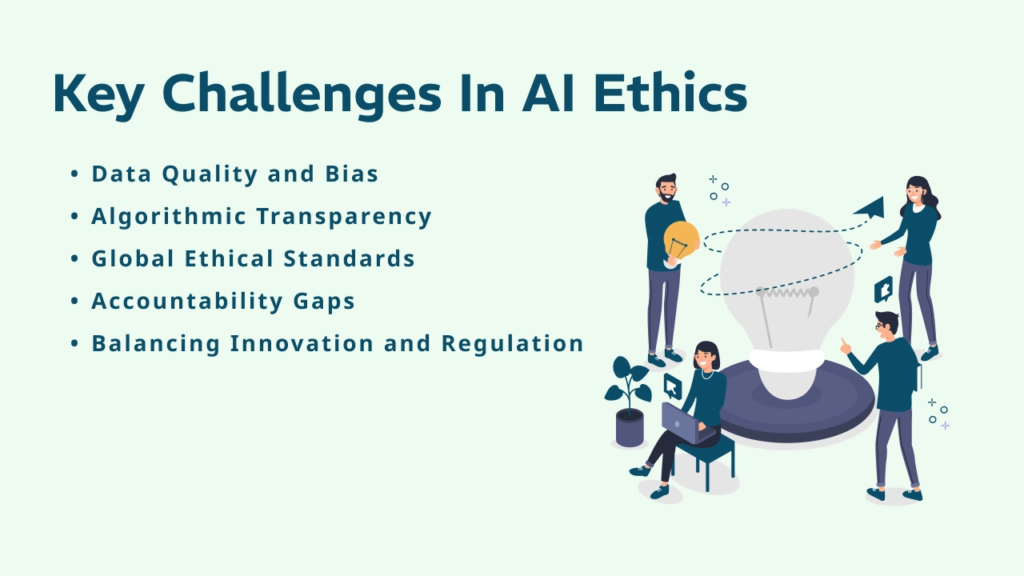
Major Ethical Challenges in Artificial Intelligence
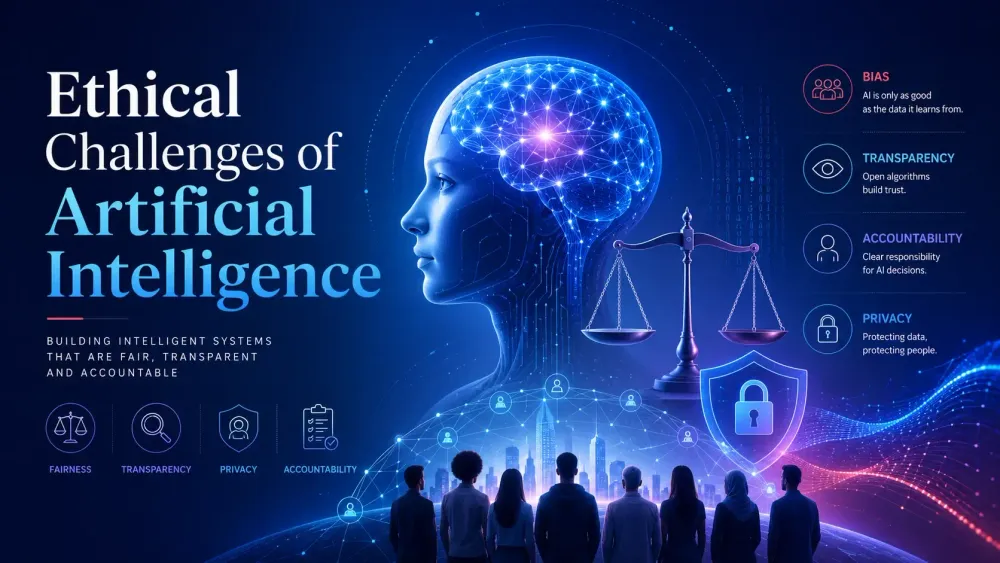
Although AI offers many advantages, its rapid development also creates challenges. Understanding these concerns helps businesses and individuals make more informed decisions about using AI technology.
| Ethical challenge | What it means | Real-world concern |
|---|---|---|
| Algorithmic bias | Unfair patterns in AI decisions | Discrimination in recruitment |
| Privacy risks | Improper collection or use of data | Exposure of personal information |
| Misinformation | AI-generated false or misleading content | Fake news and fabricated images |
| Lack of transparency | Difficult-to-understand AI decisions | Unclear automated assessments |
| Job displacement | Automation of certain tasks | Changes in employment opportunities |
| Security threats | Misuse of AI capabilities | Scams, fraud, and cyberattacks |
| Copyright concerns | Unclear rights around AI-generated content | Disputes involving creative work |
The Growing Problem of AI-Generated Misinformation
AI tools can generate realistic text, images, audio, and videos. While these capabilities are useful for creative projects and communication, they can also be misused to spread misinformation.
Deepfakes are one example. They can make it appear as though someone said or did something that never actually happened. Such content can damage reputations, influence public opinion, and create confusion.
Users should verify information before sharing it, especially when it involves important events, public figures, financial advice, or sensitive topics. AI-generated content should also be labelled where appropriate so audiences can understand its origin.
Copyright and Intellectual Property
Another important challenge concerns ownership and intellectual property. AI tools can generate articles, illustrations, music, designs, and other creative materials. However, questions remain about training data, permission, attribution, and ownership of generated work.
Content creators and businesses should understand the terms of the AI platforms they use. They should also avoid presenting copied or substantially reproduced material as entirely original work.
How to Use AI Responsibly in Everyday Life
AI ethics is not limited to technology companies. Everyday users also influence how artificial intelligence affects society. A few simple habits can help people use AI more responsibly.
Important practices to follow:
- Verify AI-generated information: Cross-check important facts with reliable sources rather than accepting every AI response as correct.
- Protect personal information: Avoid entering confidential or sensitive information into unfamiliar AI platforms.
- Respect copyright: Check content permissions before publishing AI-generated images, text, or other creative materials.
- Disclose AI assistance: Be transparent when AI has significantly contributed to academic, professional, or creative work, especially when disclosure is required.
- Avoid harmful applications: Do not use AI to create fake identities, manipulate people, spread misinformation, or invade someone’s privacy.
- Keep human judgement involved: Review AI-generated results before using them for important decisions.
These practices may seem simple, but they can make a meaningful difference in creating a safer digital environment.
AI Ethics Across Different Industries
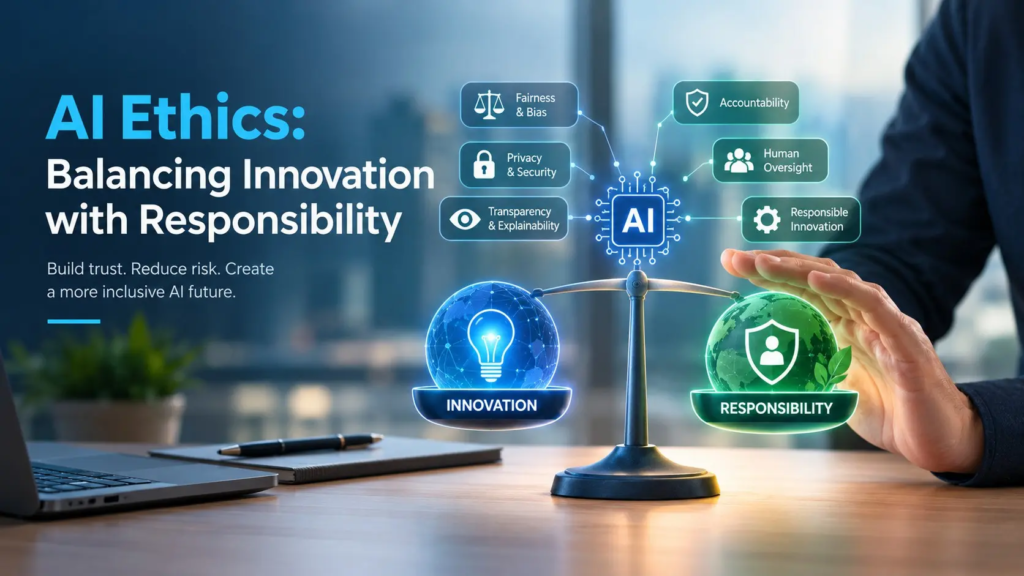
Artificial intelligence is used in many industries, and each sector faces different ethical responsibilities.
| Industry | AI applications | Important ethical considerations |
|---|---|---|
| Healthcare | Medical image analysis and health assistants | Patient privacy, accuracy, human supervision |
| Education | Personalised learning and AI tutors | Student data protection, academic honesty |
| Banking | Fraud detection and credit assessment | Fairness, transparency, security |
| Retail | Product recommendations and customer support | Data privacy, responsible personalisation |
| Recruitment | CV screening and candidate assessment | Equal opportunities and bias prevention |
| Media | Content creation and recommendation systems | Copyright, misinformation, transparency |
| Transportation | Driver assistance and autonomous systems | Public safety and accountability |
AI Ethics in Education
AI-powered learning platforms can help students understand difficult subjects, practise skills, and receive personalised explanations. However, excessive dependence on AI can affect independent thinking and academic integrity.
Educational institutions should establish clear guidelines about acceptable AI use. Students should use these tools to support learning rather than simply submit AI-generated answers as their own work.
AI Ethics in Business
Businesses increasingly use AI for marketing, customer service, data analysis, and workflow automation. These tools can improve efficiency, but companies must also consider how customer information is collected and processed.
Responsible businesses should communicate their AI practices clearly, review automated decisions, and provide ways for customers to seek human assistance when necessary.
AI Ethics in Healthcare
AI can assist medical professionals with analysing scans, organising patient information, and identifying possible health risks. However, inaccurate outputs can have serious consequences.
Medical professionals should verify AI-generated recommendations, protect patient information, and remain responsible for clinical decisions.
Responsible AI vs. Irresponsible AI
Understanding the difference between responsible and irresponsible AI makes ethical principles easier to apply in real situations.
| Responsible AI | Irresponsible AI |
|---|---|
| Protects personal information | Collects data without proper safeguards |
| Tests for bias | Ignores discriminatory outcomes |
| Communicates limitations | Presents uncertain results as facts |
| Includes human oversight | Relies blindly on automated decisions |
| Respects content rights | Uses content without considering permissions |
| Monitors security and performance | Ignores potential risks |
The difference is not simply about how advanced an AI system is. It is about whether the technology is developed and used with consideration for people and society.
The Role of Governments and AI Regulations
Governments and regulatory organisations play an important role in encouraging responsible AI development. They establish rules and standards that help protect individuals, businesses, and public institutions.
One significant example is the European Union AI Act, which introduces a risk-based regulatory framework for artificial intelligence. It places stricter requirements on certain high-risk AI applications and establishes restrictions and obligations for specific AI practices.
Other important international initiatives include the OECD AI Principles and UNESCO’s Recommendation on the Ethics of Artificial Intelligence. These frameworks promote human rights, transparency, fairness, safety, and accountability.
In India, the government has also been advancing its IndiaAI Mission and responsible AI initiatives to encourage AI development, innovation, and appropriate safeguards.
These efforts demonstrate that responsible AI is becoming an important part of global technology policy.
The Future of AI Ethics

As artificial intelligence continues to evolve, ethical considerations will become even more important. Future AI systems may become more capable of handling complex tasks, generating realistic digital content, and making recommendations across different industries.
This development creates opportunities but also introduces new responsibilities. Organisations will need better methods to evaluate AI systems, protect personal information, detect harmful outputs, and explain important automated decisions.
Some emerging areas that deserve attention include:
1. Generative AI accountability: Ensuring AI-generated content is reliable, appropriately disclosed, and not used to deceive people.
2. Human-centred AI: Designing technology that supports human needs, creativity, and decision-making instead of removing meaningful human control.
3. AI security: Protecting AI systems against manipulation, data theft, and malicious use.
4. Responsible automation: Managing workplace changes while considering employee rights, skills development, and new employment opportunities.
5. Global AI cooperation: Encouraging countries, researchers, businesses, and policymakers to develop compatible ethical standards.
The future of AI should not be measured only by how quickly machines can perform tasks. It should also be measured by how safely, fairly, and responsibly they serve humanity.
Important Things to Remember About AI Ethics
- AI-generated information is not always accurate or unbiased.
- Personal and confidential information should be handled carefully.
- Human supervision is essential for high-impact decisions.
- Transparency helps build trust between AI developers and users.
- Copyright and intellectual property rights should be respected.
- Organisations must take responsibility for the AI systems they deploy.
- Responsible AI development requires continuous testing and improvement.
FAQs
1. What is AI ethics?
AI ethics refers to principles that ensure artificial intelligence is developed and used fairly, safely, and responsibly.
2. Why is AI ethics important?
It helps protect privacy, prevent discrimination, reduce misinformation, and build trust in AI technology.
3. Can AI systems be biased?
Yes. AI can produce biased results when its training data or design contains unfair patterns.
4. Who is responsible for ethical AI?
Developers, technology companies, governments, organisations, and users all share responsibility.
5. What is responsible AI?
Responsible AI means creating and using AI systems that prioritise fairness, transparency, privacy, safety, and accountability.