
Before we dive into the deep details, let’s translate the confusing technical terms you hear everywhere into plain, everyday English.
| Tech Term | What the Corporate Jargon Says | What It Actually Means in Plain English | Should You Care? |
| Artificial Intelligence (AI) | “Synthetic human-grade cognition systems” | Teaching computers to do tasks that used to require a human brain to figure out. | Yes. It’s built into almost every app you use now. |
| Machine Learning (ML) | “Autonomous algorithmic parameter optimization” | Showing a computer a million examples so it learns to spot patterns on its own. | Yes. It’s the engine behind 90% of modern AI. |
| Generative AI | “Multi-modal contextual content synthesis” | Software that creates brand-new text, images, code, or audio based on simple prompts. | Yes. This is the stuff making all the headlines right now. |
| Narrow AI (Weak AI) | “Specialized task-execution frameworks” | An AI that is brilliant at one single job (like playing chess) but totally useless at anything else. | Yes. Literally every AI tool that exists today is Narrow AI. |
| AGI (General AI) | “Human-equivalent generalized cognitive software” | A hypothetical AI that can learn and do anything a human brain can do. | Not yet. It’s still a research concept, despite the hype. |
| Hallucination | “Stochastic output divergence variance” | When the AI gets confused, makes stuff up, and lies to your face with total confidence. | YES. The #1 reason you must double-check AI work. |
| Prompts | “Natural language contextual inputs” | The plain-English instructions or questions you type into an AI tool. | Yes. Better instructions equal way better results. |
What Is AI, Really? (Minus the Sci-Fi Nonsense)

If you ask a tech manual to define AI, it will give you a headache about neural networks and statistical probabilities. Let’s make it way simpler.
Think about how you learned to cook an omelet when you were a kid. Nobody downloaded a step-by-step code script into your brain. You watched your parents cook, you cracked a few eggs, you accidentally burned the butter once or twice, and eventually, your brain recognized the pattern of what a good omelet looks and tastes like.
Traditional software is like a rigid recipe book. A human programmer has to write explicit, line-by-line rules for every single situation: “If the user clicks Button A, open Window B. If they press Button C, crash the app.” If something happens that the programmer didn’t write a rule for, the computer throws an error and gives up.
Artificial Intelligence flips that completely upside down. Instead of giving the computer rigid rules, we feed it massive mountains of data (text, photos, spreadsheets, code) and say: “Here are a million past examples. Figure out the pattern for yourself.”
[ Traditional Software ] --> Human writes every single rule --> Computer follows blindly
[ Modern AI / ML ]      --> Human feeds massive data     --> Computer learns the patterns
When an AI chatbot writes a response to your question, it isn’t “thinking” about what it wants to say. It is running a hyper-fast probability game based on its training. It looks at the words you typed and predicts the most statistically logical words that should come next, one tiny piece at a time.
It’s basically the auto-complete on your smartphone, just scaled up by a factor of a billion and given a massive library to read.
How AI Actually Works in 4 Simple Steps

Let’s break down what actually happens when an AI system learns to do a job. It isn’t wizardry; it’s a four-stage loop that looks a lot like basic human learning.
+-------------------------------------------------------------------+
|                     THE SIMPLE AI LIFECYCLE                       |
+-------------------------------------------------------------------+
| 1. DATA COLLECTION  --> Dump thousands/millions of examples in    |
| 2. TRAINING PHASE   --> Computer spots recurring shapes/words     |
| 3. YOUR PROMPT      --> You ask a question or give a direction    |
| 4. THE OUTPUT       --> Computer builds a response based on math  |
+-------------------------------------------------------------------+
Step 1: The Data Dump (Feeding the Beast)
Before an AI can do anything useful, developers feed it massive amounts of information. If you want an AI that spots skin cancer in photos, you feed it 500,000 anonymized medical images labeled “cancerous” or “benign.” If you want an AI that writes emails, you feed it millions of public articles, books, and website pages.
Step 2: Spotting the Patterns (Training)
The computer runs through all that data over and over again, tweaking millions of tiny mathematical knobs internally. It notices subtle things humans might miss: “Ah, when these specific pixel arrangements show up on a skin scan, it’s cancer 98% of the time,” or “When someone types ‘Sincerely,’, the next word is usually their name.”
Step 3: Your Input (The Prompt)
You open a web tool and type in plain English: “Write a polite email letting my boss know I’m taking Friday off for a dentist appointment.”
Step 4: Processing & Output
The AI analyzes your prompt, compares it against the patterns it memorized during training, and constructs a fresh response word by word. It doesn’t copy-paste from an existing document; it builds a brand-new response based on the statistical rules it learned.
The 3 Big Flavors of AI: Where We Are vs. Where We’re Heading
There is a huge gap between the AI we actually use today and the futuristic stuff people talk about in podcasts. It helps to separate AI into three distinct categories.
[ Narrow AI (Today) ] -------> [ AGI (Hypothetical) ] -------> [ Superintelligence (Sci-Fi) ]
  (Great at 1 task)             (As smart as a human)           (Smarter than all humans)
1. Narrow AI (Weak AI) — What We Have Right Now
This is literally every single AI tool in existence today. Narrow AI is built to do one specific job extraordinarily well, but it has zero common sense outside of that sandbox.
- Example: An AI chess program can beat the reigning world champion in three moves. But if you ask that same chess software to write a basic pancake recipe or explain why your baby is crying, it can’t do it. It has no idea what a pancake or a baby even is.
- Everyday Examples: Spotify recommendations, Apple’s FaceID, Google Maps traffic routing, spam filters, spam detection in your inbox, and tools like ChatGPT or Claude.
2. Artificial General Intelligence (AGI) — The Holy Grail
AGI refers to a hypothetical machine that possesses generalized human intelligence. An AGI could learn to play chess, write a novel, diagnose an illness, fix a leaky sink, and learn a new language on the fly—adapting to brand-new situations without needing specialized retraining for every single task.
- The Reality Check: Despite wild hype claims from tech founders, AGI does not exist yet. Researchers are fiercely debating whether we are a decade away or a century away from making this a reality.
3. Superintelligent AI — Pure Theory and Sci-Fi
This is the theoretical concept of a system that vastly surpasses the combined intelligence of every human brain on Earth across every field—scientific creativity, wisdom, social skills, and strategic planning.
- The Reality Check: Right now, this lives strictly in science-fiction books, academic philosophy papers, and tech policy discussions. It isn’t something you need to stress about when opening your laptop tomorrow morning.
Generative AI vs. Traditional AI: What Changed Recently?
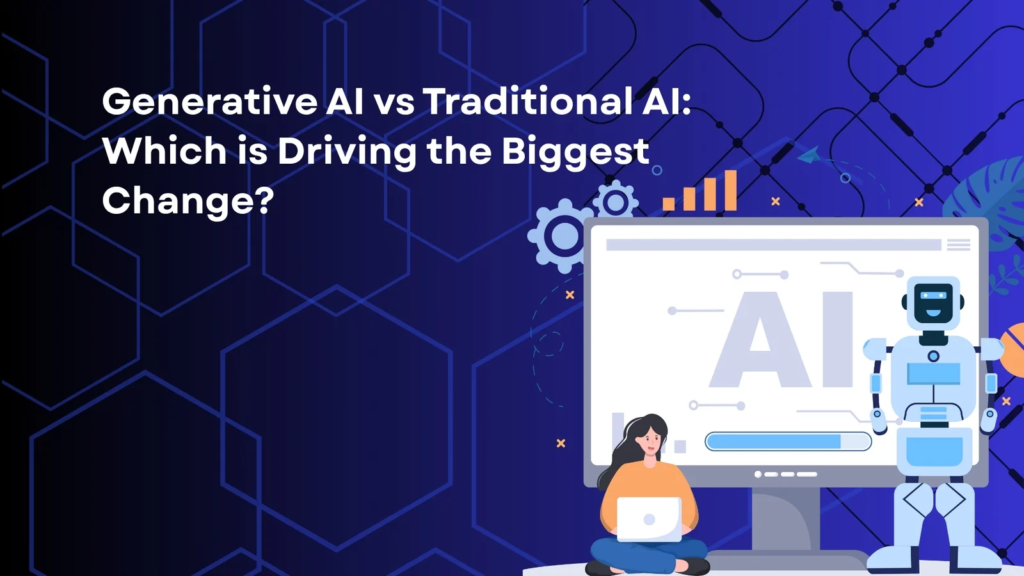
Why did AI suddenly explode into everyday conversation recently? What changed?
For years, we used Traditional (Predictive) AI behind the scenes without paying much attention to it. When Netflix suggested a movie, or your bank flagged a credit card purchase as “suspicious transaction in another state,” that was predictive AI working in the background. It looked at data and made a simple choice: Yes or No, Option A or Option B.
The game changed with Generative AI.
Instead of just organizing, categorizing, or predicting existing data, Generative AI can create brand-new stuff from scratch. You give it a text prompt, and it can generate:
- Text: Articles, summaries, translation, code, poetry, and email drafts.
- Images: Logos, realistic photos, illustrations, and UI designs.
- Audio: Podcasts with synthetic voices, background music, and voice translations.
- Video: Short video clips generated completely from text descriptions.
[ Traditional AI ] --> "Is this email spam?"          --> [ YES / NO ]
[ Generative AI  ] --> "Write a response to this email" --> [ BRAND NEW DRAFT ]
Generative AI brought artificial intelligence out of silent server rooms and put it right onto consumer screen dashboards where normal people could interact with it directly in plain human language.
Where Is AI Actually Used in Real Life? (No Tech Jargon Allowed)
You don’t need to work in Silicon Valley to interact with AI. It’s already quietly handling tasks in almost every corner of modern life:
- Healthcare: Doctors use AI to scan thousands of X-rays and MRIs in seconds, flagging tiny early-stage tumors that the human eye might accidentally miss during a long 12-hour shift.
- Personal Productivity: Summarizing hour-long meeting transcripts, cleaning up messy rough drafts, drafting quick email responses, and troubleshooting computer code errors.
- Finance: Spotting credit card fraud in milliseconds before a transaction clears, and helping ordinary people make sense of confusing tax documents.
- Travel & Navigation: Google Maps or Waze calculating real-time traffic jams and automatically rerouting you down side streets before you even see the brake lights ahead.
- Entertainment: Streaming platforms analyzing what you watch at 11:00 PM on a Sunday versus 7:00 PM on a Friday to keep your recommended feed interesting.
The Dark Side: Why AI Isn’t Perfect (and Why Humans Still Matter)

If you read marketing materials, you’d think AI is flawless. Anyone who has actually used these tools for more than an hour knows that is wildly untrue. AI has massive limitations, and understanding these flaws is the only way to use it safely.
+-------------------------------------------------------------------+
|                    THE 4 MAJOR FLAWS OF AI                        |
+-------------------------------------------------------------------+
| 1. HALLUCINATIONS  --> Lies to your face with total confidence.   |
| 2. ZERO EMPATHY    --> Understands words, but zero real feeling.  |
| 3. BIAS IN DATA    --> Garbage data in = biased answers out.      |
| 4. ZERO ORIGINALITY --> Recombines old human work; cannot feel.    |
+-------------------------------------------------------------------+
1. Hallucinations (Lying with Confidence)
When an AI doesn’t know the real answer to a question, it rarely says “I don’t know.” Because it’s a probability engine designed to keep writing words, it will frequently invent fake court cases, fake historic dates, fake scientific studies, or totally incorrect math equations—and present them with absolute, unshakable confidence.
Golden Rule: Never copy-paste facts, statistics, legal advice, or medical details from an AI without double-checking them against trusted human sources first.
2. Zero Real Understanding or Empathy
AI doesn’t “know” what love, grief, humor, or physical pain feels like. It only knows which words usually show up near those concepts in books. If you are dealing with sensitive human situations—like managing a struggling employee, handling a mental health crisis, or writing a deeply personal note—an AI response will almost always sound hollow, generic, and uncomfortably robotic.
3. “Garbage In, Garbage Out” (Bias)
AI models learn from human data, and human data is full of historical biases, inaccuracies, and toxic stereotypes. If an AI hiring tool is trained on historical resume data from a company that only hired male managers for twenty years, the AI will naturally learn that “being male” is a key pattern for success and penalize female applicants.
4. Zero Genuine Originality
AI cannot create entirely new concepts out of thin air. It can only remix, recombine, and rephrase the human work it was trained on. True creative leaps, deep emotional storytelling, and groundbreaking scientific breakthroughs still require the weird, unpredictable, lived experience of an actual human brain.
Why AI Matters Right Now in 2026
We have officially moved past the initial “honeymoon phase” of AI. The novelty of making a chatbot write a silly poem or generating a goofy picture of a cat in space has completely worn off.
In 2026, AI is becoming boring infrastructure—and that’s actually when technology gets important.
It is no longer a standalone novelty tool you open in a separate browser tab; it is quietly built directly into your word processor, your email inbox, your photo gallery, your phone’s operating system, and your workplace software.
The most valuable skill today isn’t learning how to build AI models. It’s learning how to collaborate with them effectively.
Think of AI as a hyper-capable, slightly clueless intern. If you give that intern vague, lazy instructions, they will give you terrible work. But if you give them clear directions, establish strong guardrails, and review their work with your experienced human eyes, they can handle the tedious, repetitive 70% of your workload—leaving you with more time to focus on strategy, creative decisions, and actual human connections.
- Best AI Tools 2026: Powerful Tools for Work, Business & Creativity
- AI Tutorials for Beginners 2026: Simple Guides to Get Started
- What Is AI? A Simple Guide to Artificial Intelligence in 2026
- 15 Best AI Image Generators in 2026 for Stunning Images
- AI in Smart Homes 2026: How to Automate Your Home & Save Time
Frequently Asked Questions
Q: Is AI going to steal my job?
A: For most people, AI won’t directly replace you overnight. What’s far more likely is that a person who knows how to use AI effectively will replace someone who refuses to learn. AI is great at handling repetitive data-entry, basic drafting, and routine sorting, but it stumbles badly on complex problem-solving, emotional intelligence, leadership, and hands-on physical work. Focus on developing your uniquely human skills—like empathy, critical thinking, and communication.
Q: Is my personal data safe when I type things into AI chatbots?
A: If you are using a free consumer AI tool, assume that whatever you type or upload might be used to train future versions of that model. Never type sensitive information into free AI tools—that includes personal bank details, medical records, private passwords, or confidential company secrets. Check the privacy settings on the tool you use and opt out of “data sharing for model training” if available.
Q: Why does AI writing always sound so weird and repetitive?
A: Because AI models pick the most statistically likely words, they fall into predictable habits. They love overly formal transitions (like “Furthermore,” “In conclusion,” or “Delve into”), passive voice, and florid corporate speak. If you want AI writing to sound natural, give it explicit personality guidelines in your prompt (e.g., “Write in a conversational tone, use short punchy sentences, and avoid corporate buzzwords”), and always edit the draft yourself.
Q: How can I start using AI today without getting overwhelmed?
A: Pick one small, annoying task you hate doing every week. If you hate summarizing long meeting notes, try pasting the text transcript into an AI and asking for three bullet points. If you struggle to get started on blank pages, use it to brainstorm a rough outline. Don’t try to transform your whole life overnight; treat it as an experimental assistant and see where it actually saves you time.