
Artificial Intelligence (AI) has fundamental changed how humans interact with modern technology. From voice assistants answering daily queries to self-driving cars navigating complex urban streets, AI systems have become integral to modern infrastructure. At the core of this technological shift lies deep learning, a specialized branch of machine learning that allows computers to process complex data patterns and make decisions with minimal human guidance.
For anyone entering the field of modern computing, grasping deep learning principles is a key first step. This guide breaks down what deep learning is, explores its core architecture, highlights practical real-world uses, outlines current limitations, and offers a clear learning roadmap for 2026.
What Is Deep Learning?
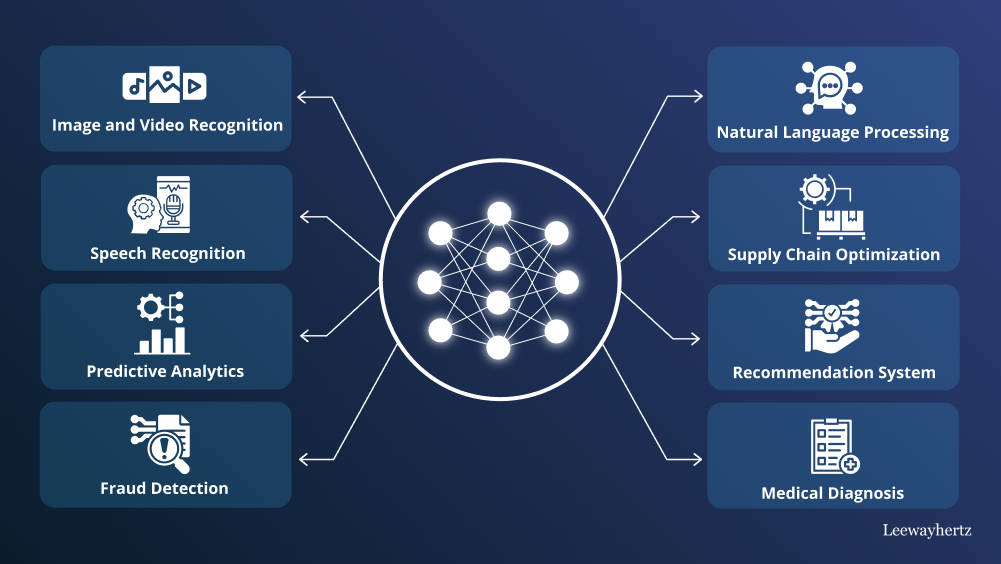
Deep learning is a subset of machine learning that relies on multi-layered artificial neural networks to analyze raw data and extract high-level patterns. Traditional machine learning often depends on engineers to manually select and format data features. In contrast, deep learning algorithms automatically extract features directly from complex, unstructured inputs.
The term “deep” refers specifically to the multiple hidden layers stacked between the input and output stages of a neural network. These extra layers enable the network to solve increasingly complex problems by building up abstractions step by step.
+-----------------------------------------------------------------------+
|                         ARTIFICIAL INTELLIGENCE                       |
|  +-----------------------------------------------------------------+  |
|  |                       MACHINE LEARNING                          |  |
|  |  +-----------------------------------------------------------+  |  |
|  |  |                     DEEP LEARNING                         |  |  |
|  |  |  • Multi-layered Artificial Neural Networks               |  |  |
|  |  |  • Automatic feature extraction from raw data             |  |  |
|  |  |  • Tailored for unstructured text, audio, and images      |  |  |
|  |  +-----------------------------------------------------------+  |  |
|  +-----------------------------------------------------------------+  |
+-----------------------------------------------------------------------+
Today, deep learning drives many critical technologies, including:
- Natural language processing and real-time translation systems.
- Computer vision applications used in medical imaging and security.
- Autonomous driving controls in modern transportation.
- Financial risk assessment and automated fraud detection.
How Deep Learning Processes Information
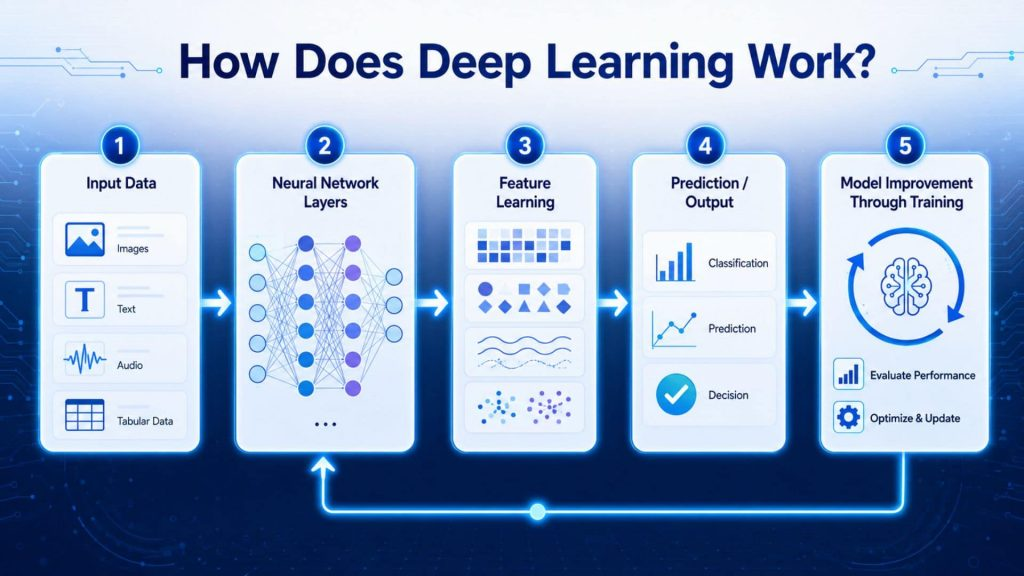
A deep learning model processes information by passing data through a structured sequence of interconnected nodes, often called artificial neurons. Information moves through the network step by step:
- Input Layer: Receives raw unstructured data, such as pixel grids, audio signals, or raw text files.
- Hidden Layers: Execute complex mathematical operations to detect edges, shapes, textures, or semantic relationships.
- Output Layer: Delivers the final prediction, such as a class label, generated sentence, or numerical score.
During training, the network evaluates its predictions against ground-truth labels using a loss function. It calculates its prediction error and uses an optimization algorithm to adjust internal connection strengths via backpropagation. Over thousands of training cycles, the model progressively minimizes error and improves its accuracy.
Comparing Machine Learning and Deep Learning
While closely related, machine learning and deep learning serve different technical requirements based on data size, computational resources, and task complexity.
| Aspect | Traditional Machine Learning | Deep Learning |
| Data Requirement | Performs well on small to medium structured datasets. | Requires large datasets to generalize effectively. |
| Feature Extraction | Requires manual feature selection by domain experts. | Features are learned automatically from raw data. |
| Hardware Dependency | Runs on standard central processing units (CPUs). | Requires GPUs or specialized TPUs for acceleration. |
| Training Time | Quick training times ranging from minutes to hours. | Long training times requiring days or weeks. |
| Primary Use Cases | Tabular data, sales forecasting, and simple classification. | Image recognition, speech synthesis, and large language models. |
Understanding Artificial Neural Networks
The structural foundation of deep learning is the Artificial Neural Network (ANN), a computational design loosely inspired by the biological structures of the human brain.
An artificial neural network relies on several core components:
- Neurons (Nodes): Computational units that receive inputs, compute weighted sums, and apply activation functions.
- Weights and Biases: Adjustable parameters that determine how much influence a specific input has on downstream neurons.
- Activation Functions: Mathematical formulas that introduce non-linearity, enabling the network to learn non-linear patterns.
- Interconnections: Directed pathways that transfer data from one layer’s neurons to the next.
 [Input Layer]           [Hidden Layer 1]        [Hidden Layer 2]         [Output Layer]

   ( Node 1 ) ------------> ( Node A ) ----------> ( Node X )
          \              /         \            /          \
           \            /           \          /            \
            -> ( Node B ) -----------> ( Node Y ) ----------> [ Final Output ]
           /            \           /          \            /
          /              \         /            \          /
   ( Node 2 ) ------------> ( Node C ) ----------> ( Node Z )
Key Technical Concepts in Deep Learning
1. Activation Functions
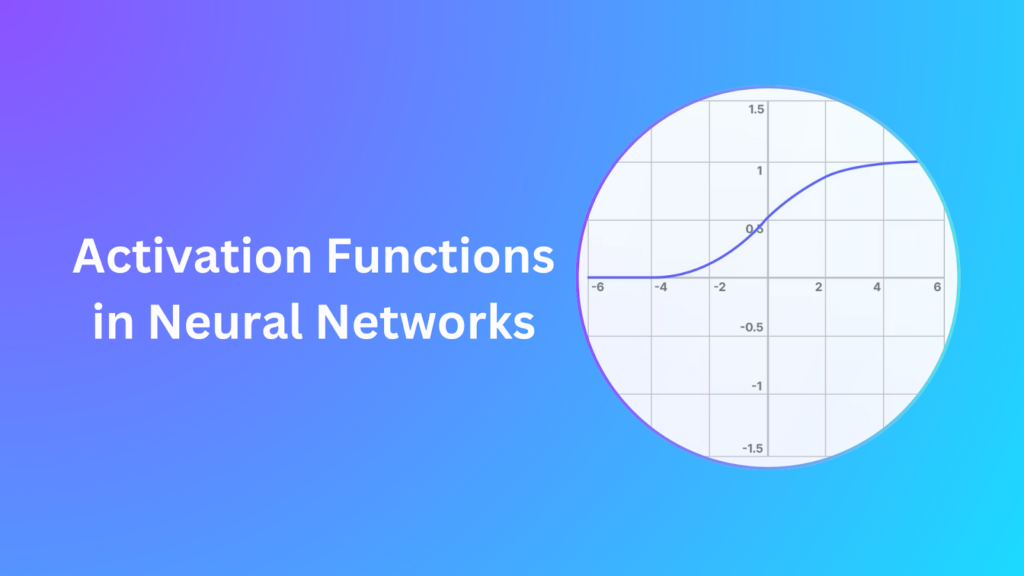
Activation functions decide whether a neuron should fire by transforming its combined input signal into an output value. Common activation functions include:
- ReLU (Rectified Linear Unit): Sets negative values to zero while keeping positive values unchanged. It is widely used in hidden layers due to its efficiency.
- Sigmoid: Maps input values into a smooth range between 0 and 1, making it useful for binary classification tasks.
- Softmax: Converts a vector of numbers into a probability distribution, making it ideal for multi-class classification outputs.
2. Loss Functions and Optimization
A loss function measures the distance between the model’s prediction and the actual target value. The primary goal during training is to minimize this value. Gradient descent is the mathematical algorithm used to adjust network weights in the direction that reduces loss most quickly.
3. Backpropagation
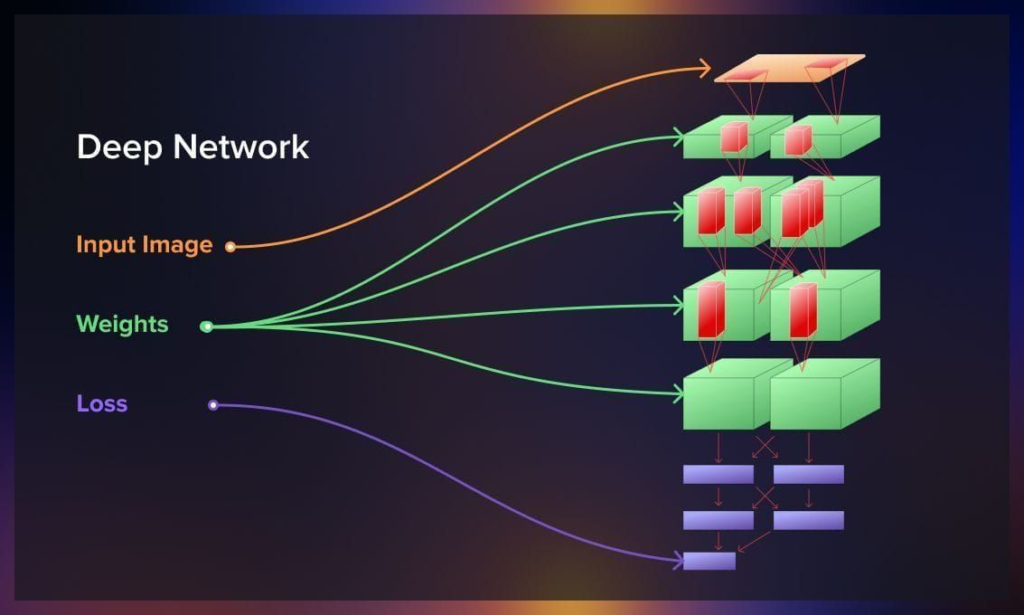
Backpropagation calculates the gradient of the loss function relative to each weight in the network, working backward from the output layer to the input layer. This process allows the network to update thousands or millions of parameters efficiently.
4. Batches and Epochs
- Batch Size: The number of training samples processed before updating internal model parameters.
- Epoch: One complete pass of the entire training dataset through the neural network.
Standard Architectures in Deep Learning
           +-------------------------------------------------------+
           |                DEEP LEARNING ARCHITECTURES            |
           +-------------------------------------------------------+
            /                          |                          \
           /                           |                           \
  [ CNN - Computer Vision ]   [ RNN - Sequential Data ]    [ Transformers - LLMs ]
  • Spatial feature maps      • Recurrence & memory cells  • Self-attention mechanisms
  • Image classification      • Time-series forecasting    • Natural language tasks
  • Object detection          • Speech recognition         • Code generation
Convolutional Neural Networks (CNNs)
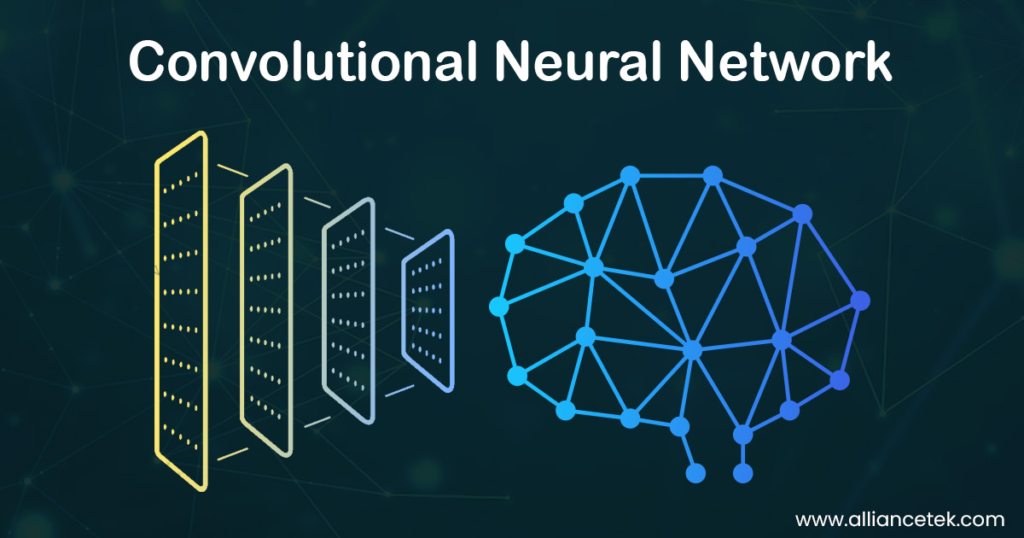
Convolutional Neural Networks specialize in processing spatial grid structures like images. By applying mathematical filters across images, CNNs capture spatial patterns regardless of where they appear in the frame.
- Primary Uses: Medical image segmentation, facial recognition, automated inspection, and visual tracking.
Recurrent Neural Networks (RNNs)
Recurrent Neural Networks handle sequential data by maintaining an internal memory state across time steps. This recurrence makes them suitable for analyzing time-ordered information.
- Primary Uses: Time-series market analysis, speech transcription, and sensor data monitoring.
Transformer Architectures

Transformers have become a foundational architecture for modern natural language processing. They use self-attention mechanisms to analyze relationships between all words in a sequence simultaneously, replacing sequential processing with parallel computation.
- Primary Uses: Large language models (LLMs), AI coding assistants, automated translation, and document summarization.
Real-World Industry Applications
Deep learning technology drives critical operations across diverse global industries:
- Healthcare: Deep learning models analyze X-rays, MRIs, and CT scans to detect early-stage tumors and structural abnormalities. They also help accelerate drug discovery pipelines by predicting molecular interactions.
- Financial Services: High-frequency trading algorithms analyze market trends, while fraud detection engines monitor transaction records in real time to prevent unauthorized charges.
- Retail and E-Commerce: Recommendation engines analyze user browsing histories to present personalized product suggestions, while computer vision optimizes inventory management in warehouses.
- Automotive and Transportation: Autonomous vehicles rely on multi-camera perception networks, radar processing, and predictive pathing algorithms to safely navigate road networks.
Primary Challenges and Technical Limitations

Despite its capabilities, deep learning presents operational challenges that developers and organizations must manage carefully:
Technical Consideration: Deep learning models require significant computational power and high-quality data. Choosing the right architecture for your data size helps avoid unnecessary hardware costs.
- Data Requirements: Deep models often need thousands or millions of labeled examples to achieve high accuracy and prevent overfitting.
- Computational Cost: Training large models requires specialized hardware clusters (GPUs/TPUs), which increases energy consumption and infrastructure costs.
- Interpretability (The “Black Box” Problem): Understanding exactly why a deep network made a specific prediction remains difficult, posing challenges for regulated fields like healthcare and lending.
- Overfitting Risks: High-capacity networks can memorize training noise instead of learning general patterns, leading to poor performance on new, unseen data.
Frameworks and Programming Tools

Building deep learning applications requires modern software tools and specialized libraries:
- Python: The primary programming language for AI development, supported by extensive mathematical libraries.
- PyTorch: Developed by Meta, PyTorch is widely used in research and production for its dynamic computation graphs and clean Python integration.
- TensorFlow and Keras: Maintained by Google, TensorFlow provides an end-to-end framework for large-scale model deployment, with Keras serving as a high-level API.
- Hugging Face Transformers: The standard library for downloading, fine-tuning, and deploying pre-trained transformer models.
Step-by-Step Learning Roadmap for Beginners
For newcomers entering the field in 2026, building a structured foundation step by step yields the best long-term results.
  Step 1: Python Basics -------> Step 2: Essential Math -------> Step 3: Classical ML
  (Variables, Loops, OOP)        (Linear Algebra, Calculus)      (Regression, Trees)
                                                                        |
                                                                        v
  Step 6: Portfolio Projects <--- Step 5: Build Neural Nets <--- Step 4: Core Frameworks
  (GitHub, Kaggle, Blogs)        (CNNs, RNNs, Transformers)      (PyTorch or TensorFlow)
- Master Python Programming: Build solid fundamentals in data structures, object-oriented programming, and scientific libraries like
NumPyandPandas. - Study Applied Mathematics: Focus on practical concepts in linear algebra, multivariable calculus, and probability theory.
- Learn Classical Machine Learning: Understand fundamental concepts like supervised learning, evaluation metrics, and cross-validation before moving to neural networks.
- Build Core Neural Networks: Implement basic neural network architectures from scratch using PyTorch or TensorFlow to understand underlying mechanics.
- Develop Practical Projects: Apply your skills to real-world datasets by building projects like digit classifiers, sentiment analyzers, or object detectors.
- Share Your Work: Publish your project code on GitHub, write technical write-ups, and participate in competitive platforms like Kaggle.
Frequently Asked Questions (FAQs)
What is deep learning in simple terms?
Deep learning is a branch of AI that uses multi-layered neural networks to learn patterns from large datasets and make intelligent predictions.
Is deep learning the same as machine learning?
No. Deep learning is a subset of machine learning that uses neural networks with many layers and usually requires more data and computing power.
Do I need coding skills to learn deep learning?
Yes. Python is the most widely used programming language for deep learning and is recommended for beginners.
Which industries use deep learning?
Healthcare, finance, retail, manufacturing, transportation, cybersecurity, education, and entertainment all use deep learning technologies.
Is deep learning difficult for beginners?
It can be challenging because it involves programming and mathematics, but with a step-by-step learning approach and regular practice, beginners can build a solid understanding.